

Good corporation bookkeeping keeps an owner’s reimbursement separate from salary, dividends and personal withdrawals. When you pay a legitimate company bill with your own money, the corporation can generally repay you without treating that repayment as employment income. The business purpose, supporting records and accounting treatment must all support that result.
For incorporated businesses in Oakville and across the GTA, the difficulty is often the paperwork between the purchase and the repayment. A credit card statement does not explain why an expense belongs to the company, and an e-transfer labelled “expenses” does not establish its tax treatment. Use the following rules to create a defensible reimbursement process.
Decide whether the expense belongs to the corporation
The first question is who incurred the expense and why, not which card paid for it. An owner can pay a corporate supplier personally, but ownership alone does not turn a personal purchase into a business cost.
Before approving repayment, establish that the purchase served the corporation’s activities. Record what was purchased, when it was purchased and how the company used it. For a mixed-use purchase, identify a reasonable business portion and keep the calculation.
Consider an owner who buys supplies for a client engagement using a personal credit card. The corporation receives the supplies, the invoice supports the purchase and the owner submits a claim. That is different from the corporation paying the owner’s household grocery bill.
Reliable corporation bookkeeping also distinguishes reimbursement from tax deductibility. The corporation might properly repay an owner for an eligible business meal while claiming only the permitted portion for income tax purposes. Similarly, equipment may belong on the balance sheet rather than being deducted immediately as an operating expense.
The bookkeeping entry should reflect the nature of the purchase. “Owner reimbursement” describes how a cost was settled, not the expense category.
Documentation rules for corporation bookkeeping
A reimbursement file should let someone who was not present understand the transaction. Keep the supplier’s invoice or detailed receipt, evidence that the owner paid it and a short explanation of the business purpose.
For meals, include the attendees and business reason. For travel, retain the itinerary and purpose of the trip. For mixed-use purchases, attach the allocation rather than asking the bookkeeper to estimate it later.
A practical claim record includes:
- Purchase details: Date, supplier, description, amount, currency and applicable taxes.
- Business explanation: Client, project or activity connected to the expense, including any personal-use adjustment.
- Payment evidence: Confirmation that the owner paid the supplier and has not already been reimbursed.
- Review trail: Claimant, approval date, reviewer and the corporation’s repayment reference.
An invoice establishes what was purchased; a bank or card record helps establish payment. Neither automatically replaces the other.
Assign responsibilities explicitly. The owner supplies the evidence, the designated reviewer checks eligibility and the bookkeeper records and reconciles the transaction. The accountant addresses uncertain tax treatment and year-end adjustments.
In a one-owner company, independent approval may not always be available. Use a documented policy, a separate review step and periodic accountant review of unusual claims rather than treating owner status as automatic approval.
Check GST/HST eligibility before recording an input tax credit
Repaying an owner does not automatically give the corporation a GST/HST input tax credit, or ITC. Registration status, commercial use, supporting documents and the legal arrangement behind the purchase all matter.
The CRA’s input tax credit guidance explains the general eligibility requirements. For owner-paid purchases, distinguish an owner acting as the corporation’s agent from an employee receiving reimbursement. Special employee reimbursement rules can apply, but being a shareholder alone does not establish employee status.
Whenever practical, have suppliers address corporate purchases to the corporation. If the receipt is in the owner’s name, review the facts rather than assuming the tax is either fully recoverable or automatically lost.
In corporation bookkeeping, tax codes should follow the evidence and applicable rules, not simply the province where the company operates. Some purchases are exempt or zero-rated, foreign taxes are not Canadian GST/HST and meals or other restricted expenses may limit recovery.
A corporation that is not registered for GST/HST generally cannot claim ITCs. In that case, unrecoverable sales tax normally forms part of the relevant expense or asset cost. Mixed commercial and personal use also requires review before any credit is claimed.
Record what the corporation owes the owner
An owner-paid corporate purchase commonly creates a credit balance in a shareholder loan account, meaning the corporation owes the shareholder. A separately identified amount payable to the owner can also be used, depending on the accounting system.
Assume an Ontario corporation registered for GST/HST purchases $200 of office supplies plus $26 HST. The invoice names the corporation, the owner pays as its agent and the purchase qualifies for a full ITC.
| Account | Debit | Credit |
|---|---|---|
| Office supplies expense | $200 | |
| GST/HST recoverable | $26 | |
| Shareholder loan payable | $226 |
When the corporation repays the owner:
| Account | Debit | Credit |
|---|---|---|
| Shareholder loan payable | $226 | |
| Corporate bank account | $226 |
The repayment clears the liability. It does not create a second expense.
This is a common corporation bookkeeping error when bank feeds are involved: the original receipt is recorded correctly, then the repayment is categorized as another office expense. Match the bank payment to the amount owing instead.
If the supplier invoice is already in accounts payable, record the owner’s payment against that invoice. Do not enter a second purchase through the reimbursement claim.
Apply separate rules to vehicles, meals and home-office costs
Personal vehicle use
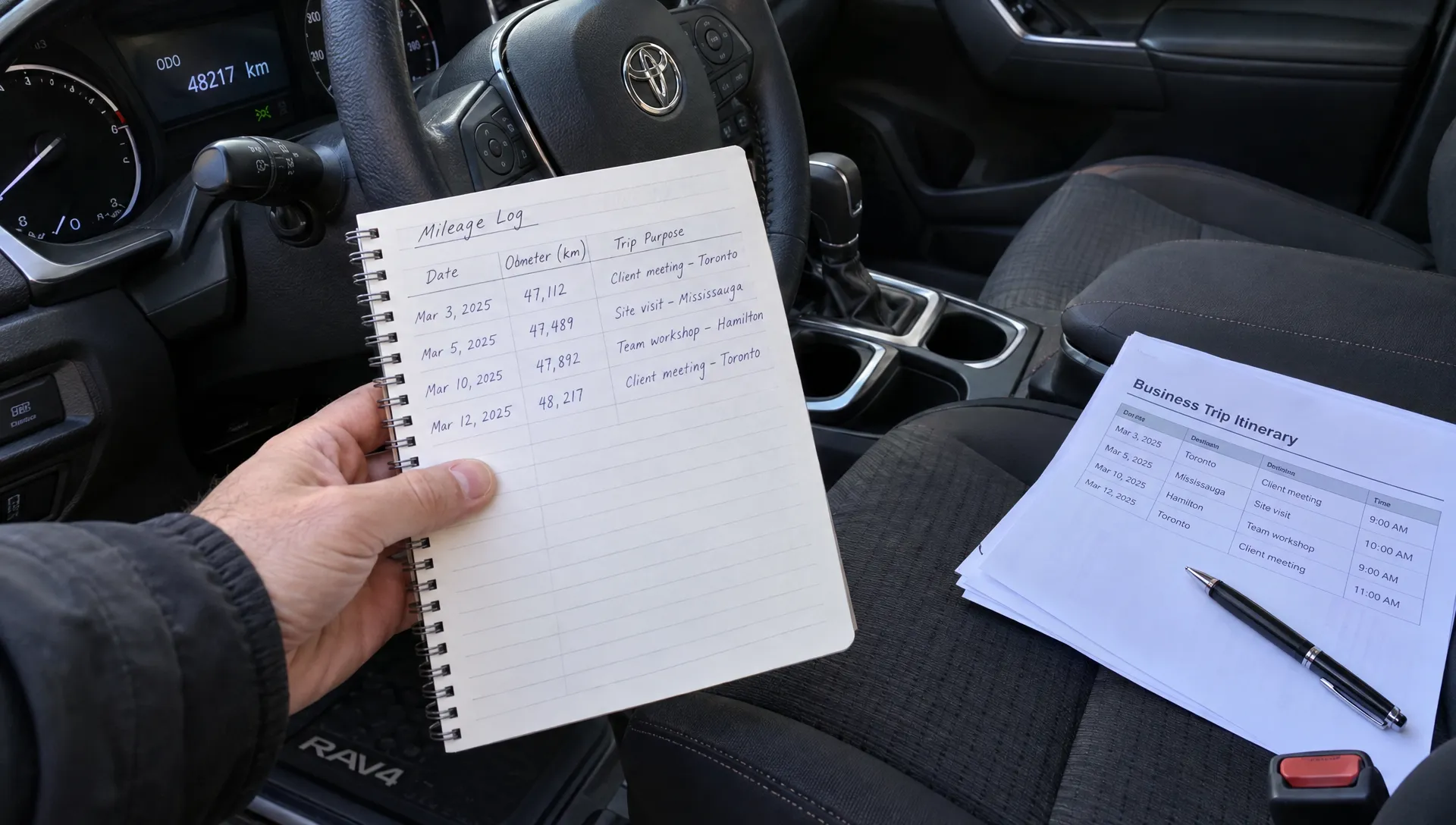
When an owner uses a personal vehicle for company business in their capacity as an employee, a reasonable per-kilometre allowance may be appropriate. Keep a log showing the date, destination, business purpose and kilometres travelled, supported by odometer records.
Ordinary travel between home and a regular workplace is generally personal commuting. A fuel receipt alone does not establish business kilometres, and paying a flat monthly amount does not automatically produce a tax-free allowance.
Check the CRA’s automobile and motor vehicle allowance guidance for the applicable year. Do not reimburse the same vehicle costs twice through overlapping mileage and actual-cost claims.
Meals, equipment and household expenses
Different purchases need different treatment even when they appear on the same claim.
| Purchase | Reimbursement and recording issue |
|---|---|
| Business meal | Document attendees and purpose. The income tax deduction is generally limited to 50%, with exceptions, and GST/HST recovery may also be restricted. |
| Computer or other equipment | Assess whether it is a capital asset and document ownership and business use. |
| Mixed-use phone or internet | Support the business allocation and review any employment-benefit implications. |
| Home-office occupancy costs | Review the arrangement before repayment. Household costs do not become corporate expenses through an unsupported percentage allocation. |
For these claims, corporation bookkeeping needs more than an expense category. A home-office arrangement may involve employment rules, a rental agreement or other tax considerations. Do not copy a sole proprietor’s home-office calculation into a corporation without reviewing whether it fits.
Keep personal financial obligations out of expense claims
The corporation is a separate legal entity. Personal mortgage payments, household purchases and costs unrelated to its business should not be classified as operating expenses merely because corporate cash paid them.
A cross-border example makes the distinction clear. An owner seeking UK repossession and property-sale support for a personally owned home is addressing a personal property matter. Any associated personal mortgage payments or legal costs do not become Canadian corporate expenses simply because the homeowner also owns a corporation.
If the company pays a personal bill, flag it promptly. Depending on the facts, it may involve a shareholder benefit, compensation or an amount owing by the shareholder. Recording a shareholder loan does not, by itself, prevent tax consequences.
Sound corporation bookkeeping distinguishes amounts the company owes the owner from amounts the owner owes the company. Shareholder-loan income inclusion, repayment timing and interest-benefit rules may need separate review. Do not assume that moving a personal charge to a loan account, or repaying it later, resolves every issue.
Reconcile claims and repayments every month
Adopt a regular submission schedule, such as monthly, so receipts and explanations arrive while the details are still available. This is an internal control, not a universal statutory reimbursement deadline.
Each month, reconcile the owner payable or shareholder loan account to submitted claims, repayments and other shareholder transactions. Investigate old balances and unmatched transfers rather than carrying them forward without explanation.
Check for duplicate claims where an owner submits a receipt that was also captured through a corporate card feed. For foreign-currency purchases, retain the original invoice and support the Canadian-dollar amount and any separately recorded conversion fees.
Payment controls matter as much as coding. Confirm changes to an owner’s banking instructions through a known contact method, restrict payment access and preserve the approval history. Reach Professional’s guide to bookkeeping controls that protect financial data explains related safeguards.
A monthly corporation bookkeeping review should also identify repayments that exceed approved claims. Investigate the difference before categorizing it as an expense, dividend or payroll payment.
Retain the records and prepare a clear year-end handoff
The CRA generally requires business records and supporting documents to be retained for six years from the end of the last tax year to which they relate. That is not always six years from the purchase date.
Exceptions and longer retention requirements apply. Records supporting property costs may remain relevant until a later disposal, and corporate historical records such as share registers and minutes can require indefinite retention. Follow any CRA direction to keep documents longer and consult its recordkeeping requirements before destroying files.
Store electronic receipts where they remain readable, searchable and linked to the accounting entry. Avoid relying on access to a former employee’s email account or a supplier portal that may later close.
At year-end, provide the accountant with the owner account reconciliation, outstanding approved claims, significant asset purchases and explanations for personal transactions. Identify expenses incurred before year-end but submitted afterward so their timing can be reviewed.
Complete corporation bookkeeping records make it easier to distinguish unpaid reimbursements from shareholder advances, dividends and payroll. Reach Professional’s guide to preparing for your first corporate year-end covers the broader handoff process.
Frequently asked questions
Does an owner reimbursement need to go through payroll? A properly supported repayment of an actual corporate business expense generally does not need to be treated as wages. Allowances, personal benefits and payments made because of share ownership require separate analysis.
Can the corporation reimburse an expense without a receipt? Request a duplicate invoice or receipt first. Payment evidence and a written explanation may help establish the facts, but missing documentation can jeopardize a deduction or ITC. Mileage allowances have their own supporting-record requirements.
Can an owner submit an expense from a previous year? A late claim needs review rather than automatic rejection or current-year expensing. Confirm that it was not previously recorded or repaid, then assess the correct accounting period, tax treatment and any adjustment required.
Can an owner be reimbursed before the corporation is profitable? Profitability is not the deciding factor. The expense must belong to the corporation, be properly supported and receive the correct accounting and tax treatment. Cash availability is a separate consideration.
Put a consistent reimbursement process in place
Owner-paid expenses should leave a clear trail from purchase to approval, accounting entry and repayment. A short policy and a reconciled owner account are more useful than correcting a year’s worth of unexplained transfers at tax time.
Reach Professional provides bookkeeping services for Oakville and GTA businesses. Book a call to discuss your owner reimbursement process, shareholder account records and purchases that need further tax review.