
Your first year-end is where everyday bookkeeping becomes a set of financial statements, tax filings and decisions about what comes next. Professional accounting and tax services should help you close the books accurately, understand your obligations and preserve enough cash to meet them.
For a new business in Oakville or the Greater Toronto Area, the challenge is often knowing what to prepare and when. The right starting point is not a folder of receipts handed over at the filing deadline. It is an agreed plan covering your business structure, reporting dates, records and responsibilities.
Confirm which year-end you are preparing for
A sole proprietorship and an incorporated business do not follow the same income tax timetable. Sole proprietors generally report business income on their personal tax returns using a calendar-year fiscal period, subject to specific alternative-method rules.
A corporation has its own tax return and fiscal year-end. Its first tax year cannot exceed 53 weeks. Choosing that date deserves attention because it affects reporting, tax payment timing and the information available for planning.
Before work begins, give your accountant your incorporation documents, business number and any CRA program account details. Confirm when business activity started and whether you incurred costs before incorporation. Those expenses need review rather than an assumption that every receipt belongs in the corporation.
What should professional accounting and tax services deliver?
“Year-end accounting” can describe very different engagements. Ask for a written scope that separates getting the records ready from preparing financial statements and filing returns.
| Work area | What to clarify for your first year-end |
|---|---|
| Bookkeeping close | Who reconciles accounts, investigates missing transactions and corrects coding? |
| Financial statements | Which statements will be prepared and under what type of engagement? |
| Income tax | Which business or personal returns are included? |
| Other compliance | Are GST/HST returns, payroll reconciliations and information slips included? |
| Owner transactions | Who reviews contributions, withdrawals, reimbursements and shareholder balances? |
| Planning | Will there be a meeting to explain results, taxes payable and next steps? |
A tax return is not a substitute for financial statements. Equally, preparing financial statements does not mean that an audit or review has been performed. Confirm whether a lender, investor or funding agreement requires a particular level of reporting before the accountant starts.
Build separate filing and payment calendars
One of the most useful parts of professional accounting and tax services is a calendar that distinguishes when paperwork is due from when money must be paid. These dates are not necessarily the same.
For most corporations, the T2 return is due six months after the tax year-end. The corporate income tax balance is generally due two months after year-end, although qualifying Canadian-controlled private corporations can have three months. The three-month rule is conditional, not automatic simply because the company is small. The CRA’s T2 Corporation Income Tax Guide explains these obligations.
For self-employed individuals, the personal return is generally due June 15, but the income tax balance is generally due April 30. Applicable weekend and public holiday rules can move a deadline.
| Obligation | What needs its own calendar entry |
|---|---|
| Income tax return | Filing deadline for the applicable taxpayer and period |
| Income tax balance | Payment deadline, which may precede filing |
| GST/HST | Filing and payment dates for the assigned reporting period |
| Payroll | Remittance dates and applicable information return deadlines |
| Instalments | Required payments during the following year, where applicable |
Do not assume your GST/HST reporting period matches your corporate fiscal year. Have the accountant verify the actual CRA account settings and any outstanding obligations.
Prepare records that explain the transactions
A bank statement shows that money moved. It may not explain what was purchased, whether GST/HST was charged or whether the transaction was personal.
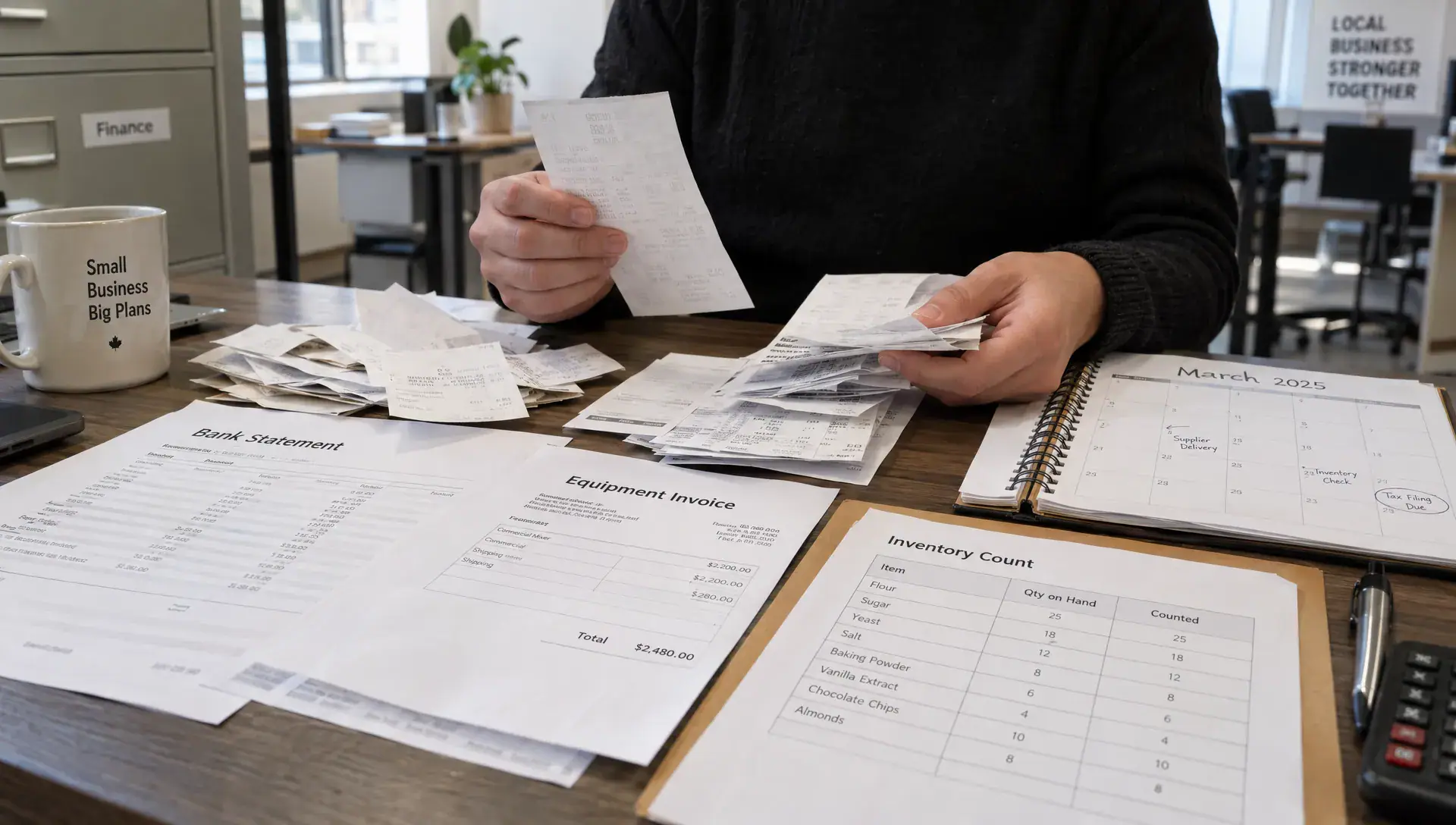
Prepare a year-end package containing:
- Bank, credit card and loan statements, including statements immediately after year-end where needed to verify outstanding items.
- Sales invoices, unpaid customer balances, supplier bills and receipts.
- Payment processor reports showing gross sales, fees, refunds and deposits.
- Payroll records, remittance details and employee benefit information.
- Equipment purchase documents, financing agreements and inventory count records, if applicable.
- Owner contributions, withdrawals, personally paid business expenses and reimbursements.
- CRA correspondence, filed returns and material contracts.
Keep a short exceptions list alongside the documents. Flag missing receipts, disputed invoices, personal charges and transactions you cannot identify. That gives the accountant a clear investigation list instead of leaving them to guess.
Well-organised records make professional accounting and tax services more efficient because the work can focus on accounting treatment rather than reconstructing what happened. If reconciliations are already behind, arranging bookkeeping support before the year-end close can address the backlog before tax preparation begins.
Review the adjustments that often surprise first-time owners
A first year-end commonly reveals differences between the bank balance, accounting profit and taxable income.
An unpaid customer invoice may belong in the reporting period even though the cash arrives later. An annual insurance payment may cover future months. Equipment may need to be recorded as an asset rather than treated entirely as a current expense, with tax deductions assessed separately under capital cost allowance rules.
Owner transactions also need attention. Money transferred into the business is not necessarily sales revenue, and a withdrawal from a corporation is not automatically a deductible wage. Shareholder loans, salary and dividends have different documentation and tax consequences. Ask before trying to fix these balances with a last-minute journal entry.
For businesses holding inventory, arrange a count at year-end and document damaged or obsolete items. If the count happens on another date, retain the records needed to reconcile movements back to year-end.
This is where professional accounting and tax services add value beyond transaction entry: the accountant connects the evidence to the correct reporting period and tax treatment. Request an explanation of material adjustments so you understand both the numbers and how to improve next year’s records.
Include licensing and other less obvious income
Businesses that own music, digital content or other intellectual property may have revenue records outside their usual invoicing system. Licensing agreements, royalty statements and enforcement settlements need to reach the accountant too.
For rights holders, Third Chair’s IP monitoring and licensing tools can help identify content uses and potential licensing opportunities. The year-end accounting evidence, however, should include relevant agreements, statements and payment records, not just a list of detected uses.
Do not assume every identified use or proposed claim is revenue. Ask how contract terms and the applicable reporting framework affect recognition. Separate amounts already earned from advances, disputed claims or payments covering future periods.
Professional accounting and tax services are more useful when these less routine income sources are identified before the books close, rather than discovered after a return has been filed.
Get a quote based on the condition of your books
There is no meaningful universal price for a first year-end. A corporation with reconciled accounts and straightforward transactions requires different work from a business with mixed personal spending, inventory and several overdue returns.
Firms may quote a fixed project fee, charge hourly or include defined year-end work in a recurring service package. These are pricing approaches, not guarantees about what any particular firm offers.
To obtain a useful estimate, explain your business structure, fiscal year-end, transaction volume, number of accounts and bookkeeping software. Identify employees, inventory, financing, foreign transactions and any missing filings. Share a current trial balance or bookkeeping report if available.
When comparing professional accounting and tax services, compare the included work before comparing the total fee. Ask whether the estimate covers cleanup, financial statements, tax returns, information slips and a results meeting. Also establish what triggers additional charges and how those charges will be approved.
A written agreement should name the taxpayer, reporting period, deliverables and responsibilities. Reviewing what belongs in a tax engagement letter can help you spot omissions before signing.
Verify qualifications, document handling and responsibilities
A CPA designation and the description “tax accountant” are not interchangeable. CPA is a regulated professional designation; “tax accountant” describes a type of work and does not itself establish that someone holds that designation.
In Ontario, check claimed CPA status through CPA Ontario’s member directory. Where the engagement requires a public accounting licence, confirm the relevant licence and firm registration as well. Ask about experience with businesses at your stage and any industry-specific issues you face.
Virtual and in-person arrangements can both work. More important is how documents are transferred, who can access them and how questions are resolved. Ask about secure upload options, multi-factor authentication, third-party access and retention practices rather than assuming ordinary email is the required channel.
Responsibility should remain explicit when buying professional accounting and tax services. The business owner supplies complete records and approves filings; the accountant performs the agreed work and identifies issues within that scope. Confirm who submits each return, who makes payments and what happens if information arrives late.
Finish with a cash plan, not just a filed return
The closing meeting should translate the completed work into decisions. Ask your accountant to reconcile accounting profit to taxable income, explain significant balance-sheet items and identify amounts payable by date.
Then look forward. What cash must remain available for income tax, GST/HST, payroll and loan repayments? Are customer balances taking too long to collect? Will instalment obligations affect next year’s cash flow?
Professional accounting and tax services should leave you with a practical set of next steps: a payment calendar, a list of unresolved matters and changes to your monthly bookkeeping routine. Keep copies of the financial statements, filed returns, adjustments and supporting schedules so next year starts from the correct closing balances.
For an incorporated business, also confirm who handles corporate registry obligations. An income tax filing does not replace a required corporate annual return.
Frequently asked questions
When should I contact an accountant about my first year-end? Ideally, before the year-end date. That leaves time to discuss your fiscal period, records, owner compensation and planning opportunities before relevant transactions or deadlines have passed.
Do I need to file if my corporation made no profit? Generally, resident corporations must file a T2 return for every tax year, even if no tax is payable or the corporation was inactive, subject to limited exceptions. Other program accounts may have separate filing obligations.
Does every new business need an audit? No. Requirements depend on legislation, governing documents, financing arrangements and other stakeholder needs. Do not purchase an assurance engagement without first establishing what is required.
Can I keep my own books and hire an accountant for year-end? Yes. Professional accounting and tax services can complement owner-managed bookkeeping. Agree on account reconciliations, supporting documents and review checkpoints early so the year-end package is usable.
Plan your first year-end with Reach Professional
Reach Professional provides accounting, bookkeeping, tax planning and compliance services for businesses in Oakville and the GTA. Whether you need help organising the records or understanding your first set of results, start by defining the work and deadlines.
Contact Reach Professional to discuss your business structure, year-end date and current bookkeeping, then agree on a scope that fits your first reporting cycle.