

Debt repayments can put pressure on an otherwise profitable business. For owners in Oakville and across the GTA, accounting advisory services can help determine whether the problem is a temporary cash shortage, an unsuitable repayment schedule or a deeper weakness in the business model. That distinction matters before asking a lender for more time or taking on replacement financing.
Restructuring business debt means changing existing obligations so the business has a more workable repayment path. It might involve extending a loan, negotiating temporary principal relief or reaching an agreement with several creditors. The objective is not simply a lower monthly payment. It is a plan the business can support while continuing to pay employees, suppliers and current taxes.
What accounting advisory services change
Bookkeeping records what happened. Advisory work uses those records to evaluate what the business can afford next and what needs to change.
In a debt restructuring, that work usually connects three questions: how much cash the business can generate, which obligations create the greatest pressure and what evidence creditors need before considering revised terms. Reliable reporting provides the foundation, but the decision depends on forward-looking analysis.
A business that earns an annual profit may still struggle because customers pay after loan instalments fall due. Another may have borrowed short-term to purchase equipment that produces returns over several years. A third may be losing money on its core operations, making a payment extension insufficient on its own.
Debt restructuring only works when the revised obligations fit a credible operating plan. An accountant can prepare forecasts, assess alternatives and explain their financial consequences. Lenders decide whether to accept a proposal, while lawyers and Licensed Insolvency Trustees handle work within their respective professional roles.
Build a complete debt picture before contacting lenders
The first practical deliverable from accounting advisory services should be a reconciled view of the business’s obligations, not an estimate based only on the latest bank withdrawal.
Accounting balances should be checked against lender statements and agreements. Differences may arise from accrued interest, financing fees, missed payments or transactions that have not yet been posted. The review should also capture liabilities that sit outside conventional bank borrowing.
A useful debt schedule includes:
- Amounts and payment dates: Principal outstanding, accrued interest, arrears, instalments and maturity dates.
- Borrowing terms: Interest rates, fixed or variable pricing, prepayment charges and renewal conditions.
- Security and guarantees: Assets pledged, personal guarantees and any restrictions on additional borrowing.
- Covenants: Financial ratios, reporting deadlines and other contractual requirements.
- Other obligations: Equipment financing, leases, supplier arrears, shareholder loans and tax balances.
Security matters because refinancing one loan may require another creditor’s consent or changes to registered security. A lower payment also does not automatically release an owner’s personal guarantee.
At the same time, examine whether overdue customer invoices are contributing to the shortage. Improving receivables management and overdue-invoice follow-up may reduce the financing gap, although collection improvements should not be treated as certain until supported by customer payment history.
Turn the cash-flow forecast into a repayment proposal
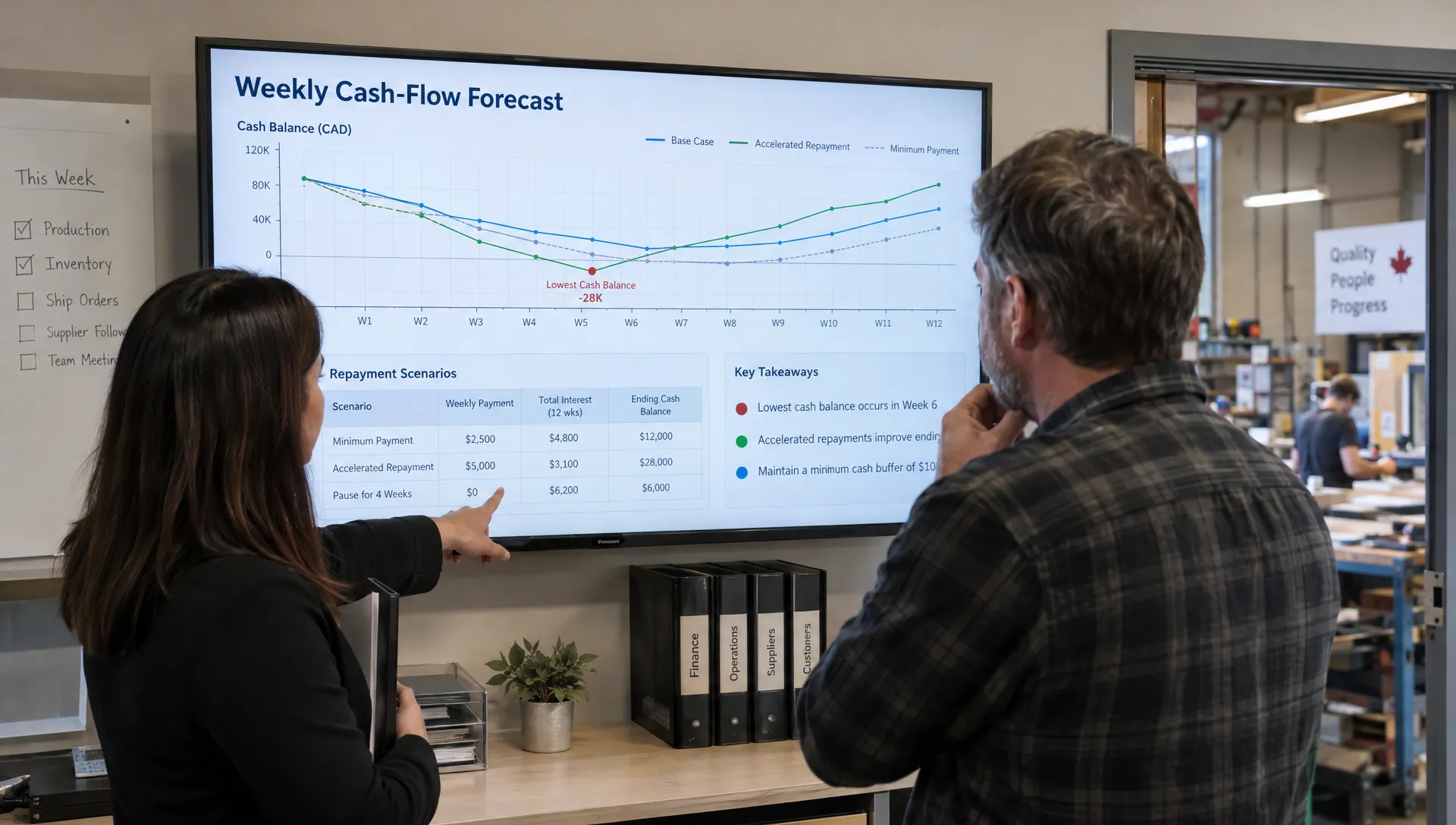
Effective accounting advisory services connect the debt schedule to a rolling cash-flow forecast. A 13-week forecast is a useful starting point because it shows weekly pressure that monthly financial statements can hide.
Begin with available cash, then map expected customer receipts against payroll, rent, supplier payments, taxes and debt service. Separate confirmed collections from optimistic assumptions. An overdue invoice is not equivalent to cash available for next Friday’s payroll.
The forecast should identify the lowest projected cash balance, when it occurs and which payments create the shortfall. It should also distinguish a temporary bridge requirement from a recurring funding deficit. If cash falls below the required operating buffer every month, extending one maturity date will not resolve the underlying issue.
A short-term forecast also needs a longer-term companion. Monthly projections can show whether proposed repayments remain affordable through seasonal changes, equipment replacement and future tax instalments. Debt-service coverage should use the lender’s contractual definition rather than an assumed generic ratio.
The resulting lender package should explain the request, its cause and the evidence supporting repayment. A specific proposal, such as revised amortization supported by forecast cash generation, is easier to assess than a general request for relief.
Compare restructuring options by total cost and risk
Accounting advisory services can help owners compare alternatives on consistent assumptions. The lowest immediate payment is not necessarily the strongest option if it creates a large balloon payment or substantially increases total borrowing costs.
| Option | Potential benefit | What needs careful review |
|---|---|---|
| Extend amortization | Reduces scheduled principal payments | Total interest, maturity date and lender conditions |
| Temporary principal relief | Preserves cash during a defined disruption | Whether interest remains payable and when principal payments resume |
| Refinance or consolidate debt | May align repayment terms with asset life or combine obligations | Fees, security, guarantees and the full cost of replacement borrowing |
| Negotiate supplier terms | May better align payments with customer collections | Supplier consent, pricing changes and continuity of supply |
| Sell a non-core asset or add equity | Can reduce borrowing without another loan | Operating consequences, tax effects and ownership dilution |
These are possibilities, not entitlements. Creditors may decline, require additional information or attach conditions. Informal arrangements depend on agreement with the affected parties and do not automatically stop enforcement.
A written comparison should include transaction costs, total projected payments and the effect on available working capital. If several lenders are involved, assess whether changes to one facility could trigger restrictions under another.
Stress-test the plan before accepting revised terms
The value of accounting advisory services becomes clearer when a proposed restructuring is tested against weaker trading conditions, not just the owner’s preferred forecast.
Consider this simplified monthly illustration. All amounts are hypothetical Canadian dollars, and operating cash payments include current operating taxes but exclude debt service.
| Monthly cash movement | Existing payments | Proposed payments | Proposed payments with lower receipts |
|---|---|---|---|
| Customer receipts | $100,000 | $100,000 | $90,000 |
| Operating cash payments | $78,000 | $78,000 | $78,000 |
| Debt payments | $28,000 | $18,000 | $18,000 |
| Net cash movement | -$6,000 | $4,000 | -$6,000 |
Reducing debt payments improves the base case, but a 10% decline in receipts restores the cash deficit. The owner still needs a response, such as a larger starting buffer, feasible cost reductions or a different financing structure. This example does not assume that a lender would offer the proposed reduction.
Industry assumptions matter too. The range of general, emergency and cosmetic dentistry at CP Dental illustrates the variety of services a clinic may provide. For a hypothetical dental-practice forecast, appointment capacity, staffing needs and treatment-payment timing deserve separate assumptions rather than one revenue-growth percentage.
For contractors, the pressure may instead come from delayed milestones. For retailers, it may come from inventory purchases before peak sales. A useful downside scenario reflects how that particular business operates.
Check the tax and financial-reporting consequences
A debt agreement can improve cash flow while creating separate accounting and tax consequences. Those effects should be assessed before signing, not discovered at year-end.
For Canadian businesses, forgiveness of commercial debt can engage the debt-forgiveness rules in section 80 of the Income Tax Act. Depending on the circumstances, a forgiven amount may reduce tax attributes and can potentially result in an income inclusion. It is unsafe to assume that a creditor’s write-off is automatically tax-free to the borrower.
Changes to interest, principal or repayment terms also require a financial-reporting assessment. A private enterprise using Accounting Standards for Private Enterprises (ASPE) and an entity using International Financial Reporting Standards (IFRS) may apply different requirements. Modification or extinguishment accounting, financing fees and current versus long-term presentation all need review.
CRA balances require separate attention. An agreement with a bank does not change GST/HST or payroll remittance obligations. Source deductions and GST/HST can involve deemed-trust rules and potential director liability, subject to legal requirements and defences.
This is where accounting advisory services should connect cash planning with tax and reporting advice. The forecast needs to reflect the actual consequences of the agreement, including new fees and continuing compliance costs.
Recognize when informal negotiations are not enough
Not every distressed business can solve its problems through a revised bank payment. Repeated missed payroll, escalating tax arrears, collection proceedings or an inability to meet obligations as they fall due warrant prompt professional assessment.
An informal workout may be workable when the business remains viable and the necessary creditors are willing to cooperate. However, one creditor’s agreement does not bind the others, and negotiations alone do not provide an automatic stay of proceedings.
A formal business proposal under the Bankruptcy and Insolvency Act is administered by a Licensed Insolvency Trustee. The Office of the Superintendent of Bankruptcy provides information about insolvency processes and the trustee profession. Legal advice is also important where enforcement, guarantees or competing creditor rights are involved.
In this setting, accounting advisory services can support the financial analysis and preparation of reliable records, but they do not replace a trustee’s statutory role or legal counsel. Early coordination helps owners understand the available paths before committing scarce cash to a plan that cannot succeed.
Choose an advisor with a clear scope and deliverables
Before engaging a firm, ask who will prepare the forecast, who will review the debt agreements and whether anyone will participate in lender discussions. These are different responsibilities and should not be assumed to be included in a general accounting engagement.
Relevant industry experience matters, but so does the ability to explain assumptions plainly. Ask how the advisor will test customer collections, identify covenant issues and update the forecast as actual results arrive.
When comparing accounting advisory services, look for defined outputs: a reconciled debt schedule, a short-term cash forecast, scenario analysis and a written comparison of options. Clarify the fee basis, information requirements and involvement of any outside specialists.
The same principles described in a well-defined professional engagement letter help establish responsibilities and avoid misunderstandings. If the firm also provides audit or review services, ask it to assess applicable independence requirements and any limits on the advisory work it can perform.
Once revised terms are signed, assign responsibility for monitoring cash balances, payment dates and covenant reporting. Compare actual results with the forecast weekly at first, then adjust the reporting frequency as conditions stabilize.
Frequently asked questions
Can a profitable business need debt restructuring? Yes. Profit does not guarantee cash is available when repayments fall due. Slow collections, seasonal inventory purchases and short repayment periods can create a cash shortage even when financial statements show a profit.
Do accounting advisory services reduce the amount a business owes? Not automatically. Advisors can assess repayment capacity and compare proposed agreements, but creditors decide whether to accept changes. Some arrangements change timing without reducing principal, and longer repayment periods may increase total interest.
Should I approach the lender before missing a payment? Where possible, discuss emerging pressure before a missed payment or covenant breach. Bring current financial statements, a debt schedule, a forecast and a specific request. Review contractual notification requirements with your advisors rather than waiting for the next renewal.
Does restructuring business debt protect a personal guarantee? Not necessarily. A guarantee may continue after payment terms change. A lawyer should review the existing guarantee and proposed documents before you assume that personal exposure has been reduced or released.
What should I prepare for an initial discussion? Gather recent financial statements, bank statements, loan agreements, lender correspondence, receivables and payables ageing reports, tax balances and details of guarantees. Include known upcoming commitments, even if they have not yet appeared in the accounts.
Start with a clearer view of repayment capacity
Before requesting new terms, establish what the business can reliably afford and which risks the proposal must address. That gives discussions with lenders a financial basis rather than relying on a hoped-for recovery.
If you are assessing accounting advisory services in Oakville or the GTA, discuss your cash-flow planning, reporting and decision-support needs with Reach Professional through its business advisory services. Clarify the scope of support required and whether legal or insolvency specialists should also be involved.