

A profitable month means little if the figures behind it cannot be explained. For an owner-managed business, reliable accounting starts with knowing that cash, receivables, debt and other balance sheet accounts are supported by evidence, not simply carried forward from last month. Balance sheet reconciliations provide that discipline. They connect recorded balances to statements, detailed schedules and underlying transactions so that errors can be corrected before they influence hiring, spending, financing or tax decisions.
What a balance sheet reconciliation actually proves
A balance sheet reconciliation compares an account’s general ledger balance with supporting evidence at a specific date. It explains any differences and documents what needs to happen next.
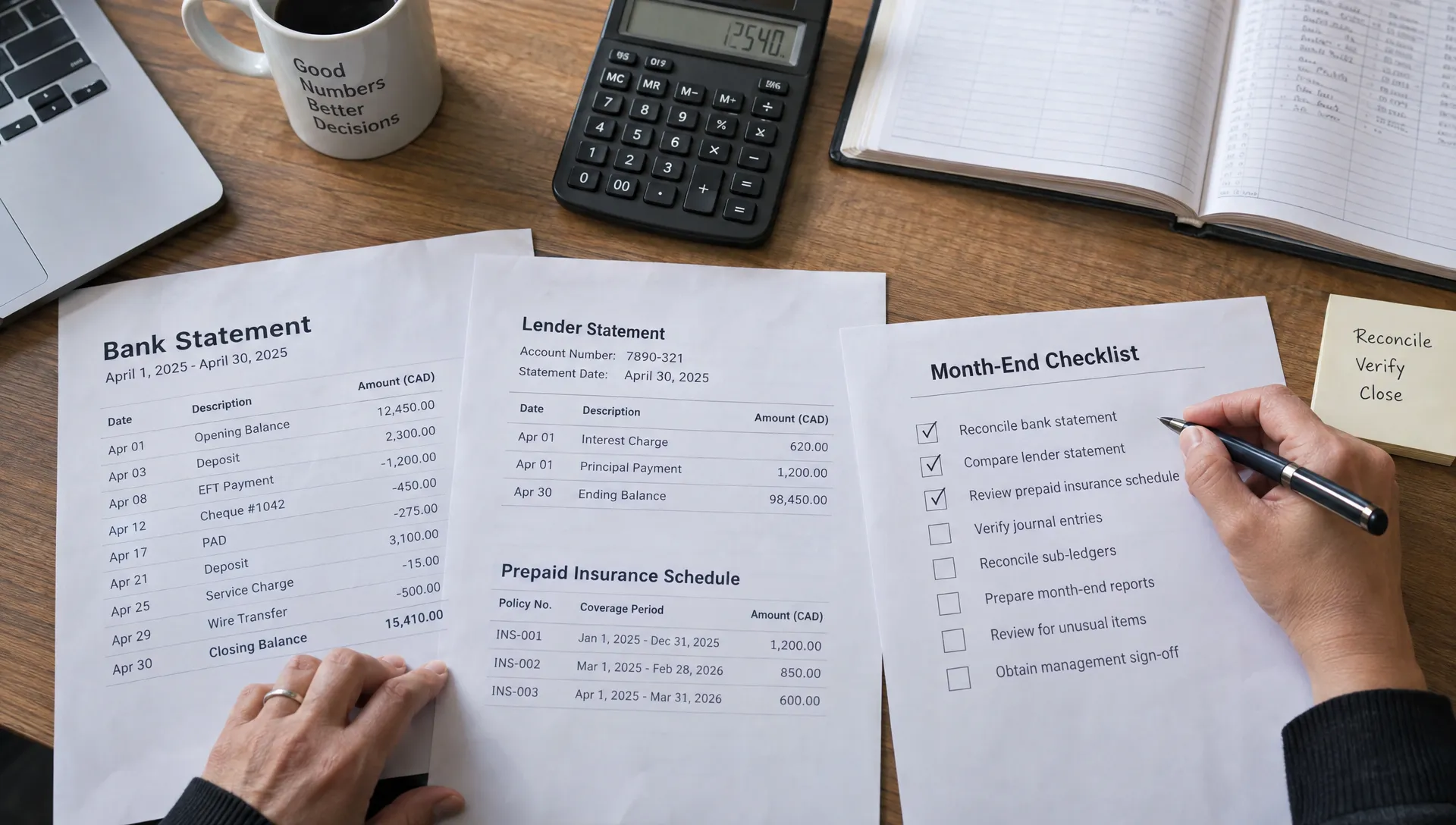
For a bank account, that means comparing the ledger with the bank statement and explaining outstanding payments or deposits in transit. For prepaid insurance, it means showing which payments still provide coverage after the reporting date. For a loan, it means supporting the principal outstanding and separating repayments from interest.
A matching total is only the starting point. The reconciliation should also address whether the balance is complete, properly valued and recorded in the correct period.
Importing transactions does not complete this work. As our guide to monitoring automated bank feeds explains, transaction matching and reconciliation to independent statements serve different purposes.
Why reliable accounting needs more than a balanced ledger
Double-entry bookkeeping keeps total debits equal to total credits. It does not guarantee that transactions were classified correctly or that every obligation was recorded.
An annual insurance premium posted entirely to expense can leave the ledger balanced while understating prepaid assets. A supplier invoice entered twice can overstate both expenses and accounts payable. An omitted accrual can make profit look stronger even though the business has already incurred the cost.
Balance sheet reconciliations help uncover these problems because they ask what supports the amount remaining at period-end. A liability needs an explanation of what the business owes. An asset needs evidence of what the business owns or expects to recover.
The consequences extend beyond year-end reporting. Unsupported receivables can distort cash forecasts. An incorrect loan balance can mislead financing discussions. Missing payroll liabilities can leave management surprised by payments already committed.
Reconciliations do not guarantee that every error or fraud will be detected. They provide a structured way to identify inconsistencies and challenge unsupported balances.
Which balance sheet accounts need supporting evidence?
For reliable accounting, the process must extend beyond the operating bank account. Each material account needs support suited to the balance and its risks.
| Account | Useful supporting evidence | Questions the reconciliation should answer |
|---|---|---|
| Cash and credit cards | Statements and outstanding-item lists | Are all accounts included? Are old outstanding items still valid? |
| Accounts receivable | Aged customer balances, invoices and subsequent receipts | Does the detail match the ledger? Are amounts collectible? |
| Accounts payable | Aged supplier balances, statements and invoices | Are balances valid? Have incurred costs been omitted? |
| Inventory | Count records, costing schedules and adjustment records | Do quantities and values reflect damage or obsolescence? |
| Prepaid expenses | Contracts, invoices and allocation schedules | How much benefit remains after period-end? |
| Property and equipment | Asset register, purchase documents and disposal records | Are additions, disposals and depreciation reflected? |
| Loans | Lender statements and repayment schedules | Are principal, interest and current portions classified appropriately? |
| GST/HST and payroll liabilities | Calculation schedules, filings, remittances and account statements | Are reporting periods and payments accounted for correctly? |
| Equity and shareholder accounts | Prior-year closing records, transaction details and authorizations | Are opening balances and owner transactions explained? |
A subledger agreeing with the general ledger is useful, but both may contain the same mistake. Supplier statements, subsequent payments and underlying documents can reveal issues that an internal comparison misses.
Build a repeatable month-end reconciliation process
The aim is not to create a large binder of paperwork. It is to make each significant balance understandable, reviewable and ready for action.
Establish the reporting date and collect evidence
Use the same reporting date across statements, ledger reports and supporting schedules. A 31 October bank statement cannot be meaningfully compared with a ledger that includes November activity unless those differences are isolated.
A reliable accounting process also identifies who prepares each reconciliation, who reviews it and when it is due. Record the source of the evidence and retain the version used for the close.
Where a third-party statement is available, obtain it rather than relying solely on transactions already imported into the accounting system. For internally generated schedules, document how the opening balance, additions and reductions produce the closing balance.
Compare balances and investigate the differences
Show the ledger balance, supported balance and reconciling items clearly. Explain each difference rather than using a label such as “timing” without further detail.
A payment recorded before month-end but clearing the bank afterward may be a legitimate timing difference. A bank charge missing from the ledger requires an entry. An unexplained amount carried forward for months needs investigation, not automatic acceptance.
Distinguish a reconciliation difference from a valuation problem. Customer invoices might total exactly the receivables control account, yet an overdue balance may still need a collectibility assessment. Reliable accounting requires both an accurate total and a reasonable assessment of what that total represents.
Record supported adjustments and check the result
When a correction is needed, document the reason, supporting evidence, affected period and approval. Post the journal entry, then confirm that the updated ledger agrees with the completed reconciliation.
Never use an unsupported adjustment simply to force agreement. Moving a difference into miscellaneous expense or a suspense account can hide the original problem and distort another balance.
Pay particular attention to cut-off. A supplier invoice received after month-end may relate to services already provided. Conversely, a payment made before month-end may cover future periods. Our explanation of cash versus accrual reporting provides further context for why payment timing and expense recognition can differ.
Review exceptions and preserve the audit trail
The reviewer should examine the evidence and explanations, not merely confirm that a spreadsheet displays zero difference. Record the review date and retain the documents that support the conclusion.
Unresolved items should have an owner, an expected resolution date and an assessment of their effect on reporting. A material uncertainty may need to be resolved before reports are issued or clearly communicated to their users.
If the same issue returns each month, correct the underlying process. Repeated missing invoices may point to purchasing or approval problems rather than a reconciliation problem alone.
Example: a balanced ledger that overstates expenses
Consider an Ontario consulting business that pays $12,000 on 1 January for insurance covering January through December. For this simplified illustration, the cost is allocated evenly across the coverage period.
The entire payment is initially posted to insurance expense. At 31 March, the bank reconciliation agrees and the trial balance balances. However, nine months of coverage remain unused.
The prepaid expense reconciliation identifies the necessary adjustment:
| Item | Before adjustment | After adjustment |
|---|---|---|
| Insurance expense for January through March | $12,000 | $3,000 |
| Prepaid insurance at 31 March | $0 | $9,000 |
| Cash effect of the adjustment | None | None |
The correcting entry debits prepaid insurance and credits insurance expense by $9,000. Compared with the unadjusted figures, assets and pre-tax profit both increase by $9,000. Cash does not change because the payment has already occurred.
This is why reliable accounting cannot be assessed by checking cash alone. The bank balance was correct throughout, but the allocation between current expense and future benefit was not.
The schedule also supports future months: the remaining prepaid balance is reduced as coverage is used. The correction therefore becomes part of an ongoing process rather than a one-time year-end fix.
Set review frequency and controls according to risk
Monthly reconciliation is a practical starting point for many active businesses, not a universal legal requirement for every account. High-volume cash or payment-clearing accounts may need more frequent attention. Less active accounts may follow a different review schedule, with periodic confirmation that nothing has been missed.
Risk matters as much as size. An unusual shareholder transaction or an unexpected payroll balance may deserve attention even when the dollar amount is relatively small. GST/HST reconciliations should distinguish amounts recorded, returns filed and payments applied, with explanations for differences between reporting periods.
Segregation of duties strengthens the process. Where possible, the person approving payments should not be the only person reconciling and reviewing the bank account. In a small team, an owner’s documented review of statements and unusual transactions can provide an additional control.
Reliable accounting does not require abandoning every spreadsheet. It requires controlled versions, clear ownership and dependable handoffs. This guide to moving from Excel to a reliable workflow without rebuilding everything explains how to retain useful spreadsheets while strengthening the process around them.
What should owners ask their accountant?
Ask to see the reconciliation status of significant balance sheet accounts, not just the finished financial statements. A useful month-end discussion identifies which balances are supported, which adjustments were posted and which exceptions remain open.
For outstanding items, ask how old they are, who is responsible and whether they affect profit, available cash or upcoming obligations. A difference described as temporary should eventually clear, and there should be evidence when it does.
Also clarify the service scope. Transaction recording, account reconciliation, management reporting and independent assurance are different activities. Having someone prepare the books does not automatically mean every balance has been reconciled or that an audit has been performed.
Look for a process that another qualified person could follow. If an account can only be explained verbally by one individual, its documentation needs improvement.
Frequently asked questions
Is a bank reconciliation enough for reliable accounting? No. It supports cash balances but does not establish whether receivables are collectible, liabilities are complete or prepaid expenses are allocated correctly. Other significant balance sheet accounts need their own supporting reconciliations.
Should every difference result in a journal entry? No. Valid timing differences may require monitoring rather than adjustment. Errors, omissions and unsupported balances need investigation, followed by an entry when the evidence supports one.
Can reconciliations wait until year-end? They can be performed then, but waiting makes errors harder to investigate and leaves interim reports less dependable. A regular close helps management identify problems while transactions and supporting details are still accessible.
Who should review reconciliations in a small business? Ideally, someone other than the preparer who understands the account and can challenge unusual items. Depending on the team, that may be an owner, controller or external accountant. Agree on responsibilities rather than assuming review is included.
Make the next month-end easier to trust
Start with your latest balance sheet. Identify which significant balances have current supporting schedules, which contain old exceptions and which have no clear owner.
Reach Professional Accounting provides accounting, bookkeeping, tax and advisory services for Oakville and GTA businesses. If your month-end figures are difficult to explain, discuss how professional bookkeeping services could support your record-keeping and close process. Confirm the reconciliation scope, review responsibilities and reporting timetable so you know what work will be completed and what remains with your team.