
A profitable month can still leave your business short of cash. That gap is one reason professional accounting services should help you understand both when income is earned and when money reaches your bank account. Cash and accrual reporting answer different questions, and confusing them can lead to poor hiring, spending or financing decisions.
For Oakville and GTA business owners, the goal is not simply to choose whichever method produces the better-looking result. It is to meet Canadian reporting requirements while keeping a clear view of profitability, unpaid obligations and available cash.
Cash vs. accrual reporting: what changes?
Cash reporting follows receipts and payments. Accrual reporting generally follows when revenue is earned and expenses are incurred. The difference is timing, not whether a transaction matters.
Suppose you complete a consulting project in December but receive payment in January. A cash-basis report generally shows the receipt in January. An accrual income statement recognizes the revenue in December, assuming the revenue recognition requirements are met, and records an account receivable until payment arrives.
| Transaction | Cash-basis view | Accrual view |
|---|---|---|
| Work completed and invoiced, but unpaid | No receipt recorded yet | Revenue and a receivable are recorded when recognition requirements are met |
| Contractor work received, with payment due later | No payment recorded yet | Expense and a payable are generally recorded when incurred |
| Annual insurance paid upfront | Payment appears when made | Cost is generally allocated over the coverage period |
| Customer pays before a service is delivered | Receipt appears when collected | Amount generally remains a liability until the revenue is earned |
These are simplified financial reporting examples, not universal tax treatments. Capital purchases, inventory and other items require additional rules.
Good professional accounting services explain these timing differences rather than presenting a bank balance as a measure of business performance.
Which method can a Canadian business use?
Income tax rules limit the choice
For most Canadian businesses, accrual accounting is required when reporting business income for tax purposes. The Canada Revenue Agency’s guidance on accounting for your earnings identifies exceptions for farmers, fishers and self-employed commission agents, subject to the applicable conditions.
A small business does not automatically qualify to use the cash method because it has few transactions, operates as a sole proprietorship or collects payment through an app. Eligibility depends on the business activity and the relevant rules.
An internal cash report is different from using the cash method on a tax return. You can monitor receipts and payments for management purposes while maintaining accrual records for tax reporting.
Financial statements have their own requirements
Financial statements prepared under Canadian Accounting Standards for Private Enterprises (ASPE) or International Financial Reporting Standards (IFRS) use accrual accounting. Other reporting bases may be appropriate for particular engagements, but they should be clearly identified.
Before changing methods, professional accounting services should establish who will use the reports: management, a lender, shareholders or the CRA. A lender may require specific financial statements, supporting schedules or covenant calculations that a cash summary cannot provide.
GST/HST is a separate timing question
Do not assume that income tax accounting determines when GST/HST must be reported. GST/HST has its own rules governing when tax becomes collectible and when input tax credits can be claimed.
For example, GST/HST can become reportable before a customer pays an invoice. Deposits and advance payments also require careful classification because their treatment can differ.
Your reporting process should therefore distinguish revenue, customer balances and sales tax liabilities. Treating the full bank deposit as sales can misstate both revenue and the amount available to spend.
A worked example: profit arrives before cash
Consider a hypothetical Ontario consulting business with a December 31 year-end. It completes and invoices an $18,000 project in December. A subcontractor completes $6,000 of related work that month. The customer pays in January, and the business pays the subcontractor in January.
Assume the revenue recognition requirements are met in December. The following comparison excludes GST/HST, other expenses and all unrelated transactions.
| December result from these transactions | Cash receipts and payments view | Accrual income statement |
|---|---|---|
| Revenue or customer receipts | $0 | $18,000 |
| Expense or contractor payments | $0 | $6,000 |
| Net contribution | $0 cash movement | $12,000 profit |
At December 31, the accrual balance sheet also includes an $18,000 receivable and a $6,000 payable. In January, collection and payment clear those balances without creating the same revenue and expense again.
This is where professional accounting services become useful beyond transaction recording: the owner needs to understand that December’s $12,000 contribution to profit is not December cash available for payroll.
The cash report alone misses the work completed. The income statement alone does not show whether the customer will pay before other obligations fall due. Both views are needed.
Deposits and prepayments need particular attention
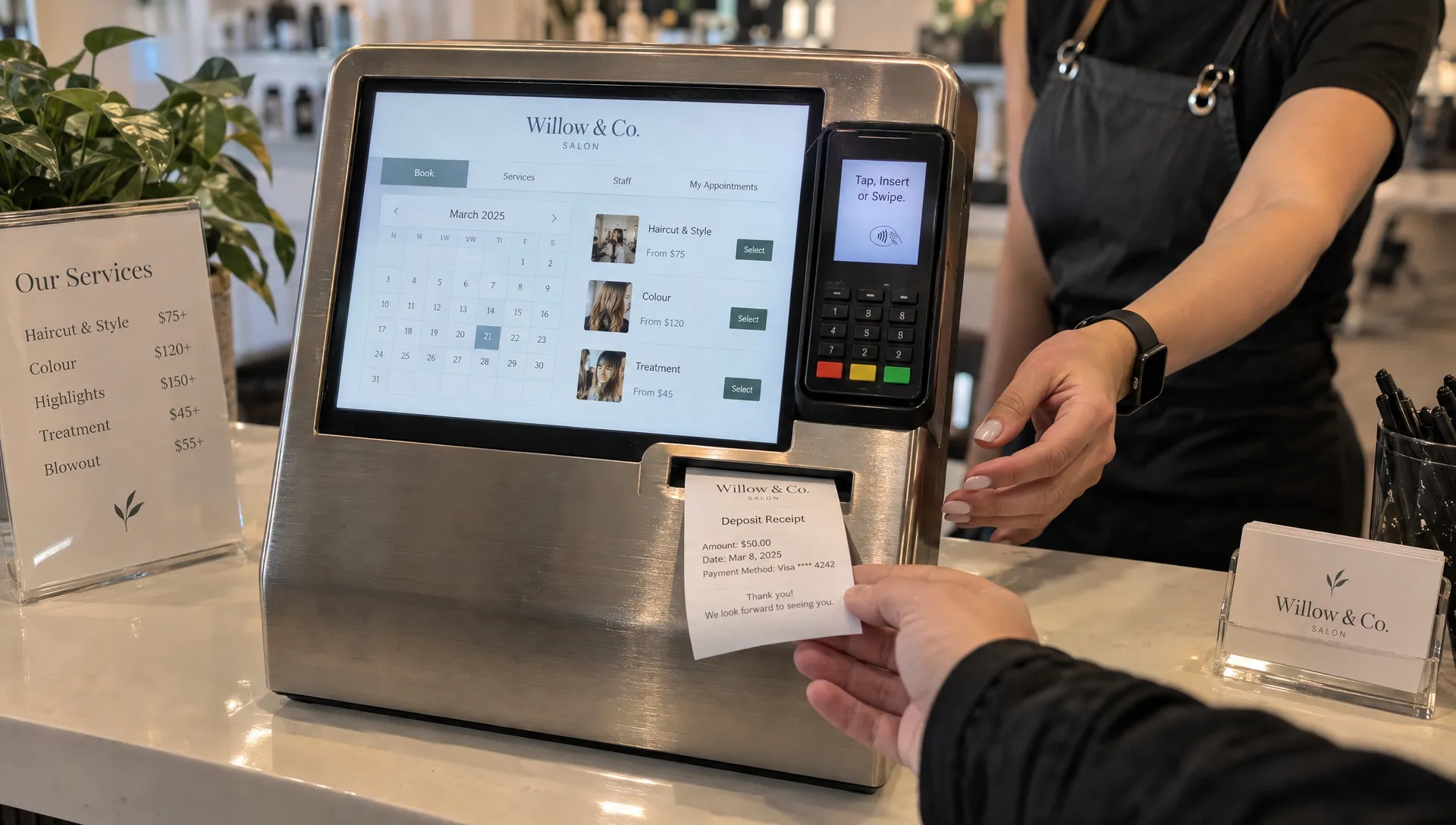
Timing issues also arise in appointment-based businesses. Consider a hypothetical Ontario salon with a service mix similar to Kimistry Hair Boutique’s hairstyling, colour and scalp treatments. A customer might pay a booking amount before an appointment and settle the remaining balance after the service.
For accrual reporting, receiving that first payment does not automatically mean all of it is earned revenue. The booking terms, refund rights and service obligations determine the appropriate treatment. The receipt still matters immediately for cash monitoring, even if it initially belongs in a liability account.
Prepaid expenses create the reverse issue. An annual insurance premium may reduce the bank balance today while covering future months. Recognizing the whole amount as one month’s expense can distort comparisons with other months.
Professional accounting services should document how these recurring transactions are treated so that deposits, cancellations and prepaid costs do not change classification depending on who enters them.
What professional accounting services should deliver each month
Useful reporting connects the income statement, balance sheet and cash position. It should explain why those reports differ, not leave the owner to reconcile them mentally.
For example, rising profit alongside declining cash might reflect slower customer collections, inventory purchases or debt repayments. Each calls for a different response. Increasing sales will not necessarily fix a collection problem, and delaying a necessary purchase will not resolve unprofitable pricing.
A repeatable month-end close
A reliable close should include the following checks:
- Reconcile bank and credit card accounts: Confirm recorded transactions agree with the underlying statements and investigate differences.
- Review receivables and payables: Identify missing invoices, duplicate bills, disputed balances and amounts assigned to the wrong period.
- Apply period-end adjustments: Record relevant accruals, prepaid expense allocations, depreciation and deferred revenue movements.
- Check payroll and tax balances: Reconcile liabilities to supporting records rather than relying only on bank withdrawals.
- Explain material movements: Identify why profit, working capital and cash changed during the month.
The frequency and detail should match the business. A company with substantial unpaid invoices or customer deposits usually needs more attention to timing than one paid immediately for every sale.
Reach Professional’s bookkeeping services for Oakville and Toronto businesses can be a starting point for discussing transaction recording and accounting-system support. Confirm separately which reconciliations, adjustments and management reports belong in your engagement.
Ask for reports that answer different decisions
Use accrual reports to assess performance
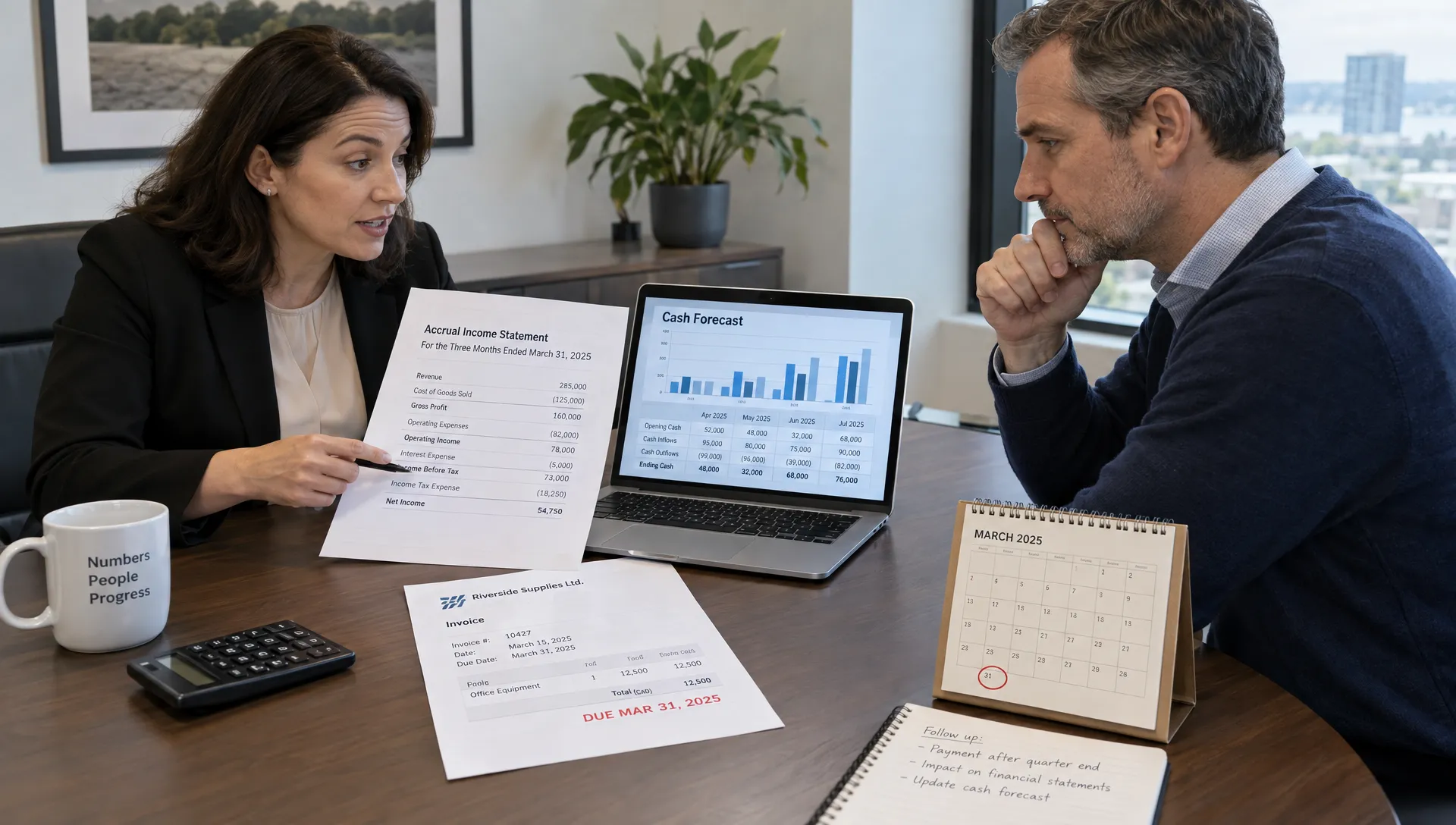
An accrual income statement helps you assess whether revenue earned during a period covers the associated operating costs. It is more useful for comparing margins when customer payments and supplier bills fall in different months.
Review it alongside the balance sheet. A strong revenue month accompanied by a large increase in overdue receivables deserves a different interpretation from a month in which customers pay promptly.
Use a cash forecast to plan payments
A short-term cash forecast starts with available cash and estimates when receipts and payments will occur. It should include items that are not ordinary income statement expenses, such as loan principal repayments and equipment purchases.
Expected collection dates matter more here than invoice dates alone. A customer balance due next week may need a later forecast date if the account is disputed or consistently late.
Use a reconciliation to connect the two
Ask for a plain-language explanation of the movement from profit to cash. Common differences include changes in receivables, payables, inventory and prepayments, along with non-cash expenses and financing transactions.
Professional accounting services add decision-making value when they connect those movements to specific actions, such as following up on a large invoice or revising the timing of an equipment purchase.
Moving from cash-focused books to accrual reporting
Changing a software setting is not the same as converting the underlying records. If unpaid customer invoices and supplier bills were never entered, switching the report view will not reconstruct them.
A conversion needs a defined date and supported opening balances. Review outstanding invoices, unpaid expenses, inventory where relevant, prepaid costs, customer advances and capital assets. Check transactions around the cut-off so income and expenses are neither omitted nor counted twice.
Keep the adjustments traceable. The owner should be able to understand where each balance came from and how subsequent collections or payments clear it.
If the change also affects tax reporting, obtain advice before filing. Method changes can involve conditions and adjustments that do not arise when simply adding an internal management report.
For owners whose reporting no longer supports financing or operating decisions, this may be a sign that financial accounting advisory services are needed beyond routine bookkeeping.
Frequently asked questions
Is cash accounting easier for a small business? It can be simpler to follow receipts and payments, but simplicity does not establish eligibility to use the cash method for Canadian income tax. Most businesses still need accrual-based tax reporting.
Can I use both cash and accrual reports? Yes. Many businesses benefit from accrual financial reports alongside cash monitoring and forecasts. The records and adjustments must support each report, and the reporting basis should be clear.
Why does my income statement show profit when cash is low? Revenue may be unpaid, cash may be tied up in inventory or money may have gone toward equipment, debt principal or owner withdrawals. Those movements do not all affect profit in the same way.
What should I ask an accounting provider? Ask whether professional accounting services include month-end adjustments, receivables and payables reviews, tax reconciliations and an explanation of profit-to-cash differences. Confirm scope, frequency and responsibilities in writing.
Get reporting that supports your next decision
Bring your latest income statement, balance sheet, bank reconciliations and outstanding invoice reports to a reporting review. Identify the decision you need to make, whether it involves hiring, financing or covering upcoming payments.
Discuss those needs through Reach Professional’s business advisory services to clarify which reporting improvements would give your Oakville or GTA business a more dependable view of profit and cash.