


A corporation can stop trading without its tax obligations stopping. For owners seeking complete business tax services, the priority is to establish what the company still needs to file, what its remaining accounts contain and whether keeping it open makes financial sense. A quiet year may require less accounting work than an active one, but inactivity is not the same as exemption.
For Oakville and GTA business owners, the practical starting point is to separate tax compliance, corporate registry requirements and plans for the company’s future.
What counts as a dormant corporation?
“Dormant” usually describes a company that has stopped operating or has not yet started. It does not, by itself, create a special tax status or close the corporation’s government accounts.
A company with no customer sales might still receive bank interest, pay insurance, own equipment or owe money to a shareholder. Those facts affect its financial statements and potentially its tax returns. A corporation holding investments or rental property may also have ongoing income even though it no longer carries on its original business.
Three situations need different treatment:
- Temporarily inactive: The owner intends to resume operations and keeps the corporation available.
- Holding remaining assets: Trading has stopped, but cash, investments, property or liabilities remain.
- Preparing to close: The owner intends to distribute remaining assets and formally dissolve the company.
Before treating a year as nil, confirm which situation applies and identify the last date of actual business activity.
What complete business tax services should cover
The work should begin with a review of the corporation’s legal status, financial records and CRA program accounts. Filing a T2 alone does not address every obligation that may continue during inactivity.
Corporate income tax returns
The CRA’s T2 Corporation Income Tax Guide explains that resident corporations generally must file a return for each tax year, including inactive corporations and those with no tax payable. Limited exceptions exist, but simply stopping sales is not one of them.
A T2 return is generally due six months after the corporation’s tax year-end. Any income tax balance is generally payable earlier, usually within two months, or three months for qualifying Canadian-controlled private corporations. Filing and payment deadlines should therefore be checked separately.
Some corporations qualify for the T2 Short Return, but inactivity alone does not establish eligibility. Outstanding years, investment income, prior losses and shareholder transactions all need review before selecting the return and supporting schedules.
For an inactive company, complete business tax services should establish a year-by-year filing position rather than assume that every outstanding return can be submitted as nil.
GST/HST and payroll accounts
A corporation registered for GST/HST generally must keep filing returns for its assigned reporting periods until its registration is cancelled, even when there is no activity. A nil return is still a return, not permission to skip the period.
Cancellation deserves its own review. Retained property and previous input tax credits can create tax consequences when registration ends. Closing the account without reviewing the assets may leave an unexpected liability.
Payroll needs a similar check. No current employees does not necessarily mean every payroll obligation has ended. Earlier wages, taxable benefits, unpaid remittances or outstanding information slips may still require attention. The accountant should also confirm whether the CRA needs a nil remittance notification or an account closure request.
For this reason, complete business tax services should include an account-by-account decision: maintain the registration, report inactivity where required or close the account properly. The right answer can differ between corporate income tax, GST/HST and payroll, even for the same company.
Corporate registry filings
A corporate annual return is different from an income tax return. It maintains corporate information with the relevant registry and does not replace the T2.
| Requirement | General timing or trigger | Effect of inactivity |
|---|---|---|
| T2 corporation income tax return | Within six months of tax year-end | Generally still required for resident corporations |
| GST/HST return | According to the assigned reporting period | Nil returns generally continue while registered |
| Ontario corporate annual return | Generally within six months of fiscal year-end | Inactivity does not remove the requirement |
| Federal corporate annual return | Within 60 days after the corporation’s anniversary date | Generally required even without business activity |
Ontario-incorporated businesses can manage registry filings through the Ontario Business Registry. Federally incorporated companies follow Corporations Canada’s requirements. Other provincial information filings may also apply, depending on registration and activities.
When arranging complete business tax services, confirm who handles annual returns, address changes and required ownership records. Do not assume the tax preparer is also maintaining the corporation’s legal records.
Keep the books accurate, even when transactions are few
A dormant company still needs a reliable opening balance, a record of current transactions and support for its closing balances. Bank fees, professional fees, interest and shareholder payments can prevent an apparently inactive year from being a true nil year.
Start by reconciling every bank account, credit card and loan. Then review amounts owing to or from shareholders. Money advanced by an owner is not automatically revenue, and money withdrawn by an owner is not automatically repayment of a loan. Some shareholder loans can create personal tax consequences if they are not addressed correctly.
Existing assets also need attention. Equipment may have been sold, retained or transferred to an owner. Receivables may have become uncollectible, while old liabilities may still be legally payable. None of these balances should disappear merely because trading stopped.
Reach Professional’s bookkeeping services can support the transaction recording and reconciliation that tax preparation depends on. For dormant corporations, complete business tax services should use those reconciled records to determine the actual income, expenses and balances to report.
Expenses also require a deductibility review. A payment is not automatically deductible simply because it came from the corporate bank account.
Define the scope before comparing accounting fees
There is no useful standard price for every dormant corporation. A company with one reconciled bank account and current filings presents a different assignment from one with missing records, several overdue returns and unresolved shareholder loans.
Ask for a scope that distinguishes recurring compliance from clean-up work. It should identify the tax years and program accounts included, the records you must supply and any registry or legal work excluded from the engagement.
A clear proposal should also explain how unexpected work will be approved. Discovering an unreported asset disposal or an overdue HST return can change the assignment after preparation begins.
Reach Professional’s guide to what a tax services engagement letter should include explains how to clarify responsibilities before work starts. This is particularly relevant when a corporation has been inactive for several years and the owner is unsure what was previously filed.
The value of complete business tax services is not the number of forms included in a package. It is a defined process for identifying obligations, correcting gaps and avoiding unnecessary work.
Decide whether to keep the corporation or dissolve it
Keeping the company available
Maintaining the corporation may make sense when there is a credible restart plan, assets need to remain in the company or contractual arrangements still require it. Compare those reasons with the continuing cost of accounting, filings, banking and legal maintenance.
Set a review date rather than leaving the decision open indefinitely. A company intended to restart next year needs a different plan from one retained without any expected business use.
Closing the company properly
Dissolution involves more than closing a bank account or marking a tax return as final. Remaining assets, debts, shareholder balances and tax accounts need to be addressed, alongside the formal corporate dissolution process.
Distributing cash or property to shareholders can have corporate and personal tax consequences. Retained earnings are not necessarily available for a tax-free withdrawal. Outstanding creditors and unresolved assessments also need attention before assets are distributed.
Coordinate the sequence with the accountant and, where appropriate, legal counsel. The final accounting period, government account closures and corporate dissolution documents must fit together.
Plan the accounting before restarting operations
Reactivation should begin with a clean opening position. Confirm that filings are current, the corporation remains in good standing and any required registrations are active before issuing invoices or hiring employees.
Review whether the proposed activity differs from the previous business. New products, customers outside Ontario, employees in another province or online sales can change the registration and tax questions that need to be answered. Existing losses should also be reviewed rather than assumed to be fully available after ownership or business changes.
A restart may involve outside work such as branding and go-to-market planning, alongside website development, equipment purchases and professional fees. Include these costs in the restart budget and ask how each should be treated for accounting and tax purposes. Some expenditures may require different treatment from routine operating expenses.
At this stage, complete business tax services should connect historical compliance with the new operating plan. That includes deciding how the owner will fund the company, documenting any shareholder advances and setting up bookkeeping before transactions accumulate.
Keeping restart spending separate from the dormant period also makes the records easier to review and supports a clearer comparison between the budget and actual results.
Prepare a useful handover file
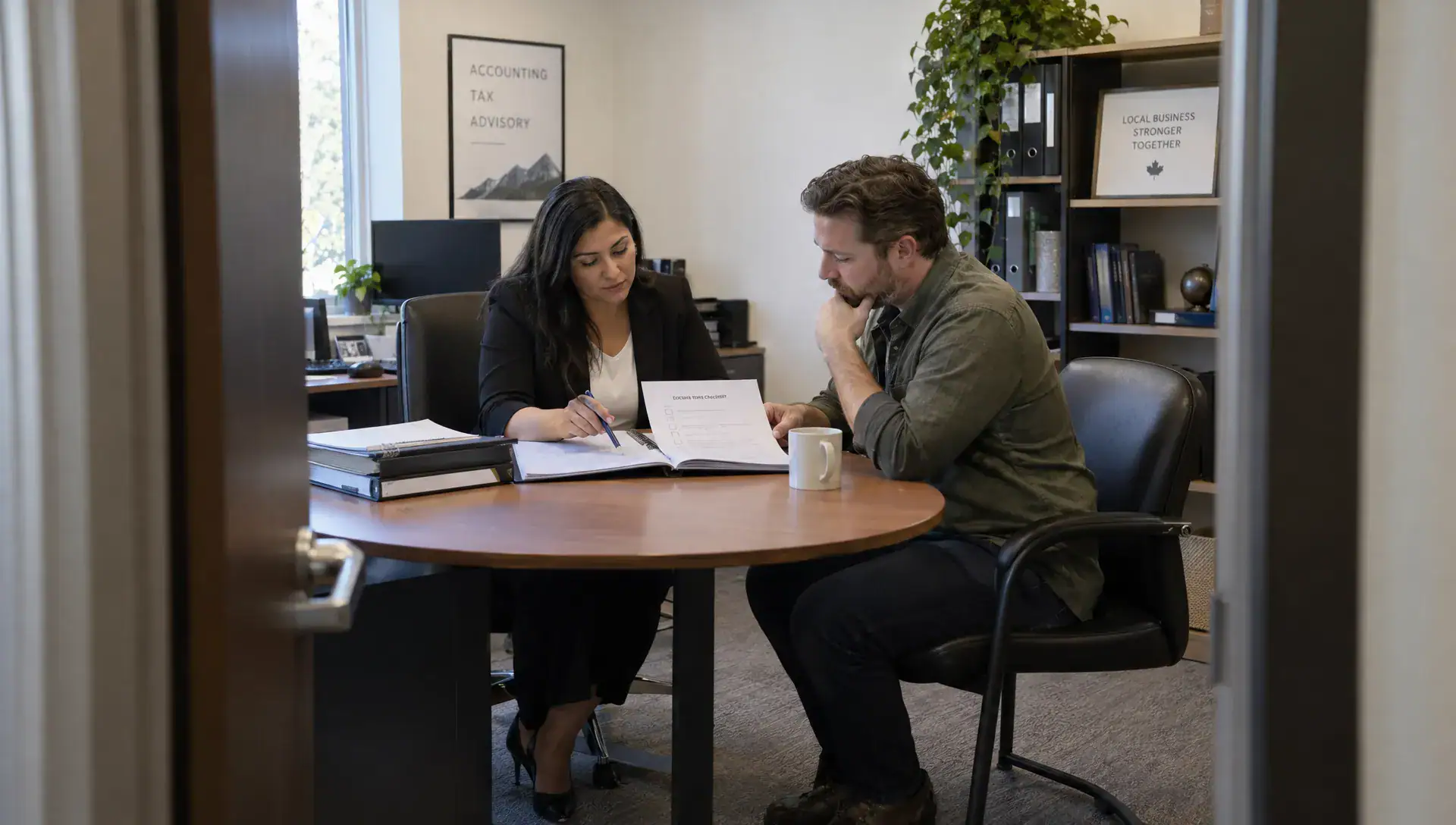
Before meeting an accountant, gather the last filed corporate return, recent notices of assessment, bank statements and access details for relevant government accounts. Include incorporation documents and any correspondence about overdue filings or registry status.
A short written timeline is especially helpful. Record when trading stopped, whether employees were paid afterwards, what assets remain and whether you intend to restart or close. Explain unusual deposits or withdrawals instead of leaving the preparer to infer their purpose from bank descriptions.
Keep supporting records even if the corporation has been inactive for years. The CRA generally requires tax records to be retained for at least six years, with different rules or longer periods applying to certain records and circumstances. Documents supporting asset costs, ownership and unresolved balances may remain relevant much longer.
A document review within complete business tax services should identify missing evidence early, before filing deadlines or dissolution plans create pressure to proceed with incomplete information.
Frequently asked questions
Does a dormant corporation need to file a T2 every year? Most Canadian-resident corporations do, even if they are inactive and owe no income tax. Limited exceptions exist. Confirm the corporation’s status rather than treating “dormant” as a filing exemption.
Is having no revenue the same as having a nil return? No. Interest income, bank charges, asset transactions and shareholder activity can still affect the return. The financial records must support the amounts reported.
Can an inactive corporation cancel its HST registration? It may be able to, depending on its circumstances. Review eligibility, remaining property, possible adjustments and the final reporting requirements before requesting cancellation.
Will an overdue nil T2 always result in a penalty? Ordinary balance-based late-filing penalties may be nil where no tax is unpaid, but other penalties or compliance consequences can apply. An overdue return should not be ignored simply because the owner expects no tax owing.
Can I leave the corporation dormant indefinitely? It can remain inactive while applicable obligations continue to be met. Periodically review whether retaining it still serves a business purpose and whether its ongoing costs are justified.
Get a clear plan for your inactive corporation
Reach Professional provides accounting, bookkeeping, tax planning and business advisory for businesses in Oakville and the GTA. If your corporation has stopped trading, bring its latest returns, account statements and your plans for its future to the discussion.
Ask what complete business tax services should include for your circumstances, from overdue filings to a properly planned restart or closure. Reach Professional’s business advisory services can help you assess the financial decision alongside the compliance work.