


Corporate tax instalments are advance payments toward a corporation’s annual income tax bill. A business tax planner calculates them by checking whether payments are required, establishing the relevant tax amounts and comparing the Canada Revenue Agency’s permitted calculation methods. The aim is to meet the payment requirements without tying up more working capital than necessary.
For an Oakville or GTA business, this involves more than dividing last year’s balance owing by 12. The calculation must account for taxable income, applicable credits, payment frequency and changes in business performance. Here is how the process works, with a practical example.
Establish whether corporate instalments are required
Corporate instalments are separate from GST/HST payments, payroll source deductions and an owner’s personal income tax instalments. Each obligation has its own rules and payment account.
The planner first checks the corporation’s current and preceding tax years against the applicable instalment requirements. Generally, instalments are not required where the relevant tax payable is $3,000 or less in either year. Federal and provincial requirements must be reviewed rather than treating this threshold as an exemption from tax.
A newly incorporated company generally does not make instalments in its first tax year, but it still needs to pay its income tax by the balance-due date. Amalgamations, reorganizations and short tax years require separate review.
For Ontario corporations, the CRA administers both federal and Ontario corporate income tax. Alberta and Quebec administer their own provincial corporate income taxes.
A business tax planner also checks whether the company must pay monthly or qualifies for quarterly payments. Quarterly payments are not an automatic option for every small business.
How a business tax planner establishes the tax amount
The starting point is the corporation’s instalment base, not its sales, bank balance or remaining amount owing after previous payments.
For a straightforward Ontario corporation, the calculation considers federal and Ontario corporate income tax, adjusted for applicable credits and other relevant items. More complex corporations may have additional taxes to include. The CRA’s T2 Corporation Income Tax Guide explains the applicable corporate payment rules.
A planner typically reviews the latest filed T2 return, notices of assessment, previous instalment calculations and year-to-date financial statements. These records establish the historical amounts and support a current-year estimate.
Reconcile accounting profit to taxable income
Financial statement profit and taxable income are not interchangeable. For example, accounting depreciation is generally added back, while an eligible capital cost allowance deduction is calculated separately. Non-deductible expenses, loss carryforwards and other tax adjustments can also change the result.
The planner then applies the relevant tax rates and credits. Eligibility for the small business deduction, associated corporations, passive investment income and business-limit restrictions can affect that calculation.
Reliable financial statements and accounting records help establish this starting point. If expenses are missing or revenue is recorded in the wrong period, the tax forecast can be misleading even when the instalment arithmetic is correct.
Compare the three CRA calculation methods
A business tax planner compares the permitted methods before recommending a schedule. For a standard 12-month tax year with monthly payments, the three approaches are broadly as follows:
- Current-year method: Divide estimated current-year tax by 12.
- Previous-year method: Divide the preceding year’s instalment base by 12.
- Combination method: Base the first two payments on the second preceding year, then calculate the remaining 10 payments using the preceding year’s instalment base, less the first two calculated payments.
The historical methods can provide a predictable payment schedule without requiring a precise current-year forecast. The current-year method can reduce payments when tax is expected to fall, but an underestimate creates interest exposure.
A worked monthly example
Assume an Ontario corporation has the following instalment bases after applicable adjustments:
| Tax year | Illustrative instalment base |
|---|---|
| Current year, estimated | $36,000 |
| Preceding year | $48,000 |
| Second preceding year | $24,000 |
These are hypothetical tax amounts, not revenues or quoted tax rates. Assume a full 12-month year with no special adjustments.
| Calculation method | First two monthly payments | Remaining 10 monthly payments | Annual scheduled total |
|---|---|---|---|
| Current-year estimate | $3,000 each | $3,000 each | $36,000 |
| Preceding-year base | $4,000 each | $4,000 each | $48,000 |
| Combination method | $2,000 each | $4,400 each | $48,000 |
For the combination method, the first two payments are each $24,000 ÷ 12 = $2,000. The remaining payments are ($48,000 − $4,000) ÷ 10 = $4,400 each.
Choose a defensible schedule, not simply the lowest payment
The combination method preserves more cash during the first two months, but its scheduled annual total remains $48,000. It changes payment timing rather than reducing annual tax.
The current-year method produces the lowest annual payments in this example. That only makes it appropriate if the $36,000 forecast is supportable.
A business tax planner weighs that forecast against the protection offered by a correctly calculated historical method. Paying according to a permitted historical method can avoid instalment interest even when the eventual current-year tax bill is higher, provided the required payments are made on time. The additional tax still becomes payable at the balance-due date.
The CRA generally assesses instalment interest using the permitted calculation that produces the least interest. That does not make an unsupported estimate safe: if actual tax is higher and payments fall below the applicable requirement, interest can arise.
Check whether quarterly payments are available
Qualifying Canadian-controlled private corporations, or CCPCs, may pay quarterly instead of monthly. Eligibility includes a perfect compliance history, small business deduction conditions and income and taxable-capital tests involving associated corporations.
A business should not infer eligibility from its size or CCPC status alone. Late filings or remittances can affect the compliance test, and associated companies can affect the financial tests.
Using the same illustrative tax amounts, quarterly calculations would be:
| Calculation method | First quarterly payment | Remaining three quarterly payments |
|---|---|---|
| Current-year estimate | $9,000 | $9,000 each |
| Preceding-year base | $12,000 | $12,000 each |
| Combination method | $6,000 | $14,000 each |
Under the quarterly combination method, the first payment is $24,000 ÷ 4 = $6,000. Each remaining payment is ($48,000 − $6,000) ÷ 3 = $14,000.
Quarterly payments create fewer deadlines but larger individual cash outflows. The company still needs to reserve cash between payment dates.
Put instalments and the final balance on separate calendars
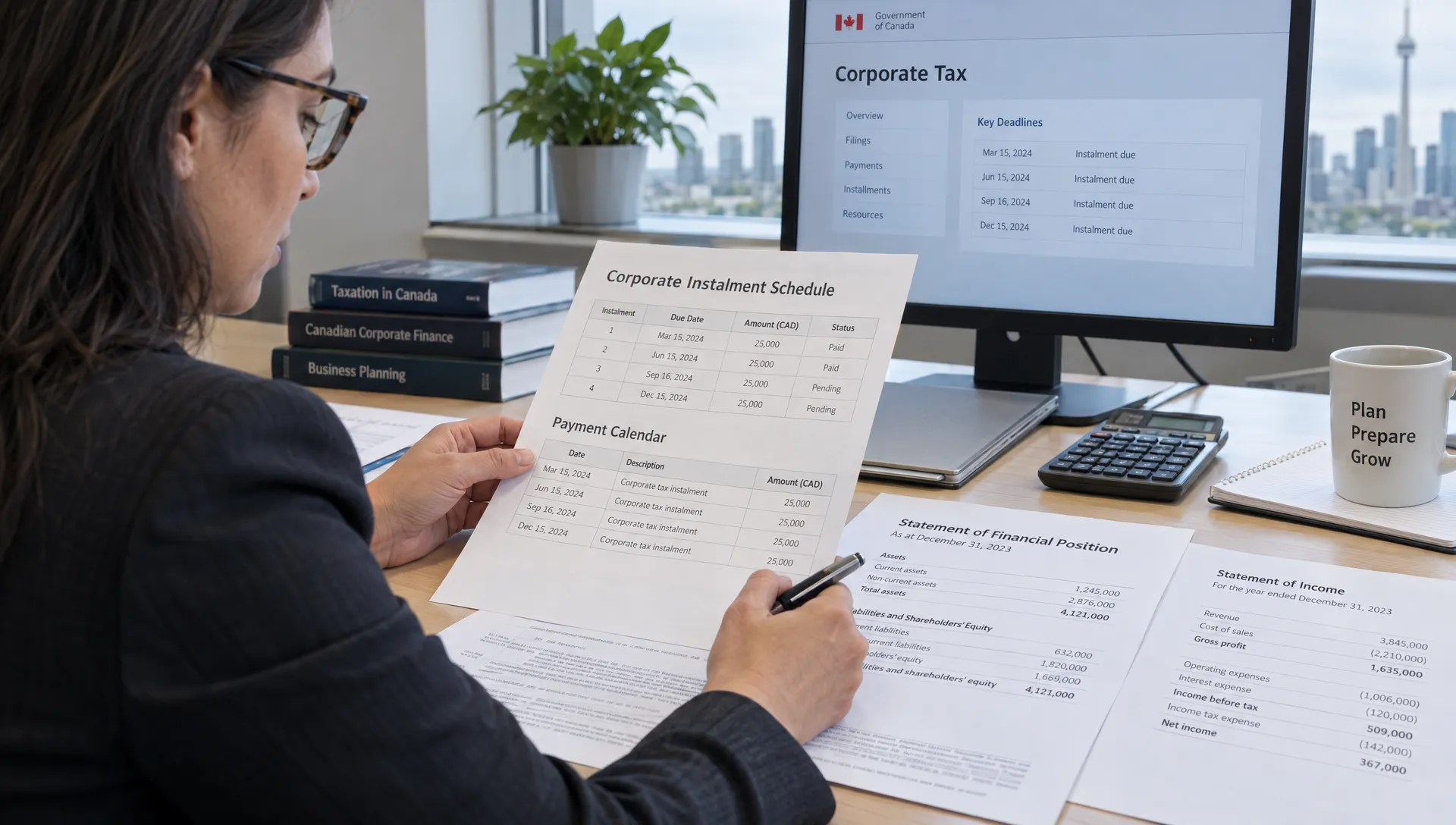
For a corporation with a December 31 year-end and a standard 12-month tax year, monthly instalments are generally due on the last day of each calendar month. Eligible quarterly payments are generally due March 31, June 30, September 30 and December 31.
A business tax planner maps these deadlines to the corporation’s actual tax year. A non-calendar year-end or short tax year requires its own schedule. The CRA’s next-business-day rules apply when a deadline falls on a weekend or recognized holiday, but payment processing time should still be allowed for.
The T2 filing deadline is not the tax payment deadline. A corporate return is generally due six months after year-end. The income tax balance is generally due two months after year-end, with a three-month deadline available to certain qualifying CCPCs.
In the example, suppose the company pays $36,000 in instalments but its final tax is $42,000. The remaining $6,000 is payable by the applicable balance-due date. Whether instalment interest also applies depends on the required payment amounts and timing throughout the year.
Paying the final balance on time does not automatically eliminate interest from earlier instalment shortfalls.
Reforecast when profit changes
A tax forecast should change when the underlying business changes. A large contract, lost customer, asset sale or unexpected margin improvement can make an earlier estimate unreliable.
A business tax planner revisits the estimate using year-to-date results and a forecast for the remaining months. The review should distinguish recurring changes from one-off transactions and consider their tax treatment, not just their accounting presentation.
For example, receiving a large customer deposit does not necessarily mean the entire receipt becomes taxable income immediately. Likewise, buying equipment does not automatically create a full deduction equal to its purchase price.
The example’s $36,000 estimate might rise to $42,000 after a strong quarter. The planner would assess payments already made, upcoming deadlines and the available calculation methods before recommending an adjustment.
The reverse also matters. If expected tax falls, reducing instalments may preserve cash, but the revised estimate needs evidence. Simply having less money in the bank does not establish a lower tax liability.
Reviewing budget variances before they grow helps identify whether a change in profit is temporary, recurring or caused by incomplete bookkeeping.
Account for interest and payment allocation
The CRA charges instalment interest on deficient or late payments using prescribed rates that can change quarterly. Interest is compounded daily. Current rates are available on the CRA’s prescribed interest rates page.
A separate instalment penalty can also apply when instalment interest exceeds $1,000, subject to the CRA’s calculation rules.
Before treating a payment as complete, verify that it reached the correct corporation income tax account and tax year. A payment allocated to GST/HST or payroll does not automatically satisfy the corporate income tax obligation.
A business tax planner also reconciles payment confirmations against the CRA account. A catch-up payment can reduce further interest exposure, but it does not necessarily erase interest already accrued. Early or excess payments may generate instalment credit interest that offsets instalment debit interest under the CRA’s rules; this is not the same as earning a cash return on surplus funds.
Connect the calculation to working capital
A useful instalment schedule shows both the legal deadlines and how the business will fund each payment. That may mean reserving cash monthly even when payments are quarterly, or maintaining a separate forecast for the final balance.
The forecast needs clear ownership. Someone must update expected revenue, someone must close the books and someone must approve and release payments. Unassigned tasks are a common reason a sound calculation does not become an on-time payment.
If marketing activity is not translating into a usable revenue outlook, this guide to diagnosing growth bottlenecks through measurement and workflow ownership offers a relevant operational check. Better revenue visibility can support the forecast, although it does not determine Canadian tax treatment.
The business tax planner then connects that operating information to estimated taxable income and payment requirements. The practical output should be a documented calculation, dated payment schedule, review trigger and identified person responsible for each payment.
Frequently asked questions
Can we calculate instalments from last year’s balance owing? Not reliably. The balance owing reflects payments and credits already applied. Instalments use the relevant tax base under the chosen method, so a return showing a small balance can still support substantial instalments.
Can we reduce instalments if profits are falling? Yes, the current-year method may support lower payments. The forecast must reflect taxable income and applicable tax adjustments. If the estimate is too low, instalment interest may apply.
Do instalments reduce the corporation’s total tax? No. They are advance payments credited toward annual tax. Choosing a method changes the required payment amounts and timing, not the final tax liability.
Do all CCPCs get quarterly payments and a three-month balance deadline? No. These are separate rules with separate eligibility conditions. Qualifying for one does not automatically establish eligibility for the other.
Get an instalment schedule you can act on
Reach Professional Accounting provides accounting, tax planning and business advisory services for Oakville and GTA businesses. If your instalments no longer match your financial results, a business tax planner can help assess the available methods and identify what needs updating.
Bring your latest T2 return, notices of assessment, instalment payment history and current financial statements to the discussion. Reach Professional’s business advisory services can help connect the tax payment schedule with broader cash-flow and business decisions.