


Subscription businesses can collect cash months before they earn it. That makes accounting services especially important for owners who need to distinguish healthy recurring revenue from money already committed to future service delivery. A strong bank balance does not necessarily mean strong monthly profitability, and rising subscription sales can hide refunds, failed payments or increasing support costs.
For businesses in Oakville and across the GTA, the goal is more than accurate bookkeeping. It is a reliable monthly view of earned revenue, outstanding obligations, customer retention and available cash, supported by accounting policies that match the subscription agreement.
What accounting services should cover for subscription revenue
A subscription-specific accounting process connects customer contracts, billing records, payment processor activity and the general ledger. Recording the deposits that reach your bank account is only one part of that work.
The monthly close should produce:
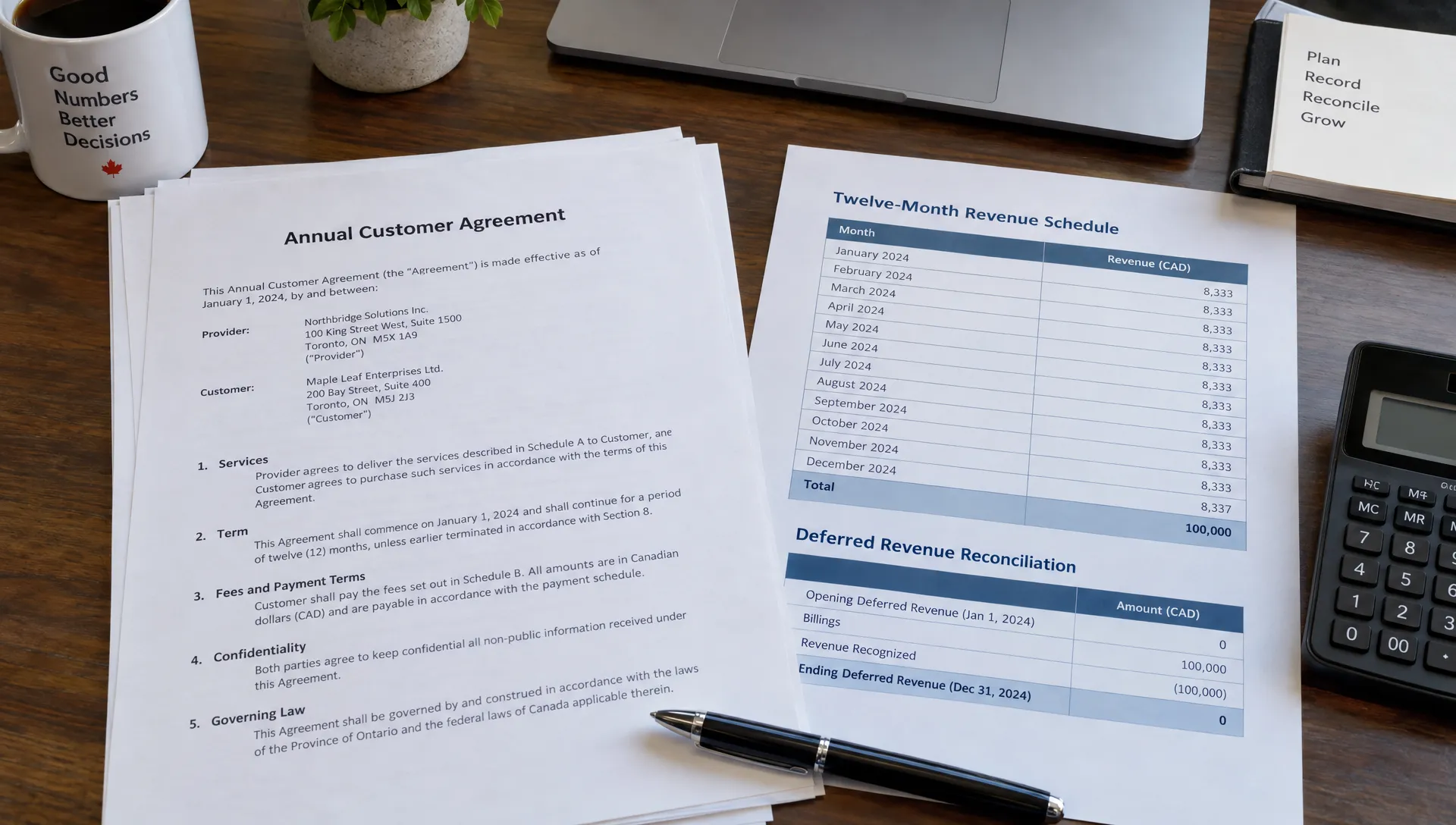
- A revenue schedule: Amounts earned during the period, separated from advance payments for future service.
- A deferred revenue reconciliation: Opening balances, new advance billings, revenue recognized and closing balances.
- A billing-to-bank reconciliation: Invoices and payments matched to refunds, processing fees, chargebacks and deposits.
- A subscription performance report: Consistently defined measures of recurring revenue, retention and service delivery costs.
- A tax review: Sales tax and income tax considerations assessed separately from financial reporting.
Each report should have an owner, a source of supporting information and a review deadline. Otherwise, unresolved differences can carry forward while management relies on incomplete numbers.
Effective accounting services make these reports explain the same business from different angles: what customers owe, what the company has earned and what cash remains available. They should also flag exceptions, such as an annual renewal recorded entirely as current-month revenue.
Separate cash received from revenue earned
Consider a customer who pays $12,000 on January 1 for twelve months of access to a service. Assume the service is provided evenly throughout the year, the full payment relates to that access and there are no separate deliverables or refund adjustments. The example excludes sales tax.
Under those assumptions, the business would generally recognize $1,000 of revenue each month rather than the full $12,000 in January. The unearned portion remains a liability, commonly called deferred revenue or, under IFRS terminology, a contract liability.
| Reporting date | Cash received during the month | Revenue earned to date | Remaining deferred revenue |
|---|---|---|---|
| January 31 | $12,000 | $1,000 | $11,000 |
| February 28 | $0 | $2,000 | $10,000 |
| December 31 | $0 | $12,000 | $0 |
This distinction changes how owners interpret performance. January’s cash receipt helps fund operations, but it also comes with an obligation to serve the customer for the rest of the year. Spending the entire amount immediately could leave the business short of cash later.
The deferred revenue schedule should reconcile to the general ledger every month. Accounting services should also identify contracts that do not fit the simple example, including usage-based charges, milestone deliverables and service periods that begin partway through a month.
Set revenue policies around the actual customer agreement
Canadian businesses do not all use the same financial reporting framework. Many private enterprises use Accounting Standards for Private Enterprises (ASPE), while others report under IFRS. The applicable framework matters when assessing revenue recognition.
Under IFRS 15, Revenue from Contracts with Customers, the analysis includes identifying performance obligations and determining when they are satisfied. A business reporting under ASPE needs an assessment under its applicable revenue guidance, not an automatic adoption of IFRS terminology and conclusions.
Review setup charges, onboarding, bundled support and cancellation rights. A non-refundable setup fee is not automatically revenue on the day it is collected. Its treatment depends on what the customer receives and the reporting framework. Similarly, an upgrade may require an adjustment to the remaining revenue schedule.
For activity-based subscriptions, identify the services promised to participants. Ons Plekske’s description of work, study, sport and leisure opportunities, from a Dutch day programme for young people with intellectual disabilities and/or autism, illustrates how varied a programme’s activities can be. A Canadian organization selling a comparable mix through recurring fees would still need to assess its own agreements, rather than infer accounting treatment from a service description.
Document these conclusions in a short policy supported by representative contracts. Consistent accounting services apply that policy to new plans and exceptions instead of making a fresh assumption every month.
Reconcile subscription billing before posting revenue
Subscription systems and payment processors answer different questions. The billing platform tracks customer charges and account status. The processor tracks collections and settlements. The bank shows net deposits. None of those records, on its own, establishes earned revenue.
Suppose a processor collects $10,000, deducts $300 in fees and processes $500 in refunds. Ignoring sales tax and other adjustments, the resulting bank deposit is $9,200. Posting that deposit directly to revenue would obscure the fees and refunds. It would also overlook whether some collections relate to future service periods.
Reconcile gross collections to settlement reports, then settlement reports to bank deposits. Separately, connect customer billings and credits to receivables and revenue schedules. Check settlement timing at month-end so a deposit arriving next month does not disappear from the reconciliation.
Failed payments need their own review. An unsuccessful renewal charge does not, by itself, establish whether service continued or whether a collectible receivable exists. Contract terms and customer account status determine the next step. Businesses dealing with payment follow-up can also benefit from bookkeeping practices that reduce overdue invoices.
Reliable accounting services preserve these distinctions while providing a clear exception list: unmatched payments, unresolved refunds, disputed charges and overdue accounts requiring action.
Use recurring revenue metrics without confusing them with accounting revenue
Monthly recurring revenue (MRR) is a management metric, not a substitute for revenue reported in financial statements. A business might normalize a $12,000 annual subscription to $1,000 of MRR even though the customer pays only once a year.
Annual recurring revenue (ARR) is often calculated as twelve times MRR. That does not mean the amount is guaranteed cash, contracted backlog or revenue already earned. Define which subscriptions qualify and how discounts, delinquent accounts, cancellations and variable charges are treated. Keep sales tax and one-time fees out of recurring subscription metrics.
A useful monthly MRR bridge starts with the opening balance, adds new subscriptions and expansion, then subtracts downgrades and churn. The closing balance should agree with the underlying customer data. Consistent definitions matter more than presenting a favourable number.
Retention should sit beside profitability. Net revenue retention measures how recurring revenue from an existing customer group changes after expansion, contraction and churn, excluding new customers. It can improve even while delivery costs rise enough to reduce margins.
Accounting services should connect those operating measures to recognized revenue, gross margin and cash flow. For example, customer growth accompanied by declining margins may point to higher hosting costs, heavier support requirements or pricing that no longer covers service delivery.
Review Canadian tax timing separately
Financial reporting treatment does not automatically determine tax treatment. A payment deferred for accounting purposes may require a separate income tax analysis, including whether a statutory reserve is available and how it applies to the business’s circumstances.
GST/HST also follows its own timing rules. Generally, tax on a taxable supply becomes payable on the earlier of when consideration is paid and when it becomes due, subject to exceptions. An annual advance payment can therefore create a sales tax obligation before all the related accounting revenue is recognized.
For Canadian subscription businesses, the review should cover registration requirements, the nature of the supply, place-of-supply rules and customer location. Selling outside Ontario does not automatically mean Ontario HST applies, and selling internationally does not automatically make a supply zero-rated. The CRA’s GST/HST guidance for businesses provides a starting point for these questions.
Keep collected sales tax separate from revenue and from the deferred revenue schedule. Changes to products, customer geography or contract terms should trigger a tax review rather than wait until year-end.
For subscription businesses, accounting services should make these timing differences visible so owners do not mistake tax collections or advance customer payments for unrestricted operating funds.
Turn subscription reporting into a cash forecast
Annual prepayments can make cash flow look strong while creating months of future delivery costs. A forecast should therefore model both collection timing and the expenses required to honour existing subscriptions.
Start with expected receipts by billing frequency: monthly renewals, annual renewals, new customers and usage charges. Then model refunds, collection delays, payroll, contractors, software infrastructure, sales tax remittances and other operating payments. Include the timing of major annual expenses rather than spreading every cost evenly across the year.
Use a rolling short-term cash forecast alongside a longer operating forecast. The short-term view helps manage payment commitments; the longer view tests whether pricing, retention and margins support the growth plan.
Scenario assumptions should be explicit. For example, compare the base forecast with slower annual renewals or increased cancellations. These are planning scenarios, not predictions. Their purpose is to show when management would need to reduce spending, adjust pricing or seek financing.
Businesses that need help translating reports into decisions may benefit from business advisory and CFO support. The analysis becomes more useful when accounting services connect the customer data to a practical decision, such as whether the business can afford another hire before its next renewal cycle.
Choose an accounting scope that fits your subscription model
Before engaging an accountant, provide sample agreements, pricing plans, refund policies and reports from your billing and payment systems. Include examples of unusual transactions, such as mid-term upgrades, paused subscriptions or annual contracts with onboarding fees.
Ask how the proposed engagement will address deferred revenue, reconciliations, tax timing and management reporting. A year-end engagement may not include monthly revenue schedules or recurring revenue analysis. Those deliverables should be stated rather than assumed.
Also clarify responsibility for source data. Your team may need to maintain customer start dates, service periods, plan changes and cancellation records. Even accurate general ledger work cannot compensate for missing contract information.
A useful monthly reporting package should let you trace material balances back to their source. It should also explain adjustments in plain language, particularly when billing totals, MRR and recognized revenue differ. If a lender requests reporting, confirm the type of financial statements or assurance required before commissioning the work.
The right accounting services are not defined by the longest list of reports. They are defined by whether the agreed scope produces reliable numbers, identifies exceptions promptly and gives management enough information to act before a cash or compliance problem grows.
Frequently asked questions
Is an annual subscription payment revenue immediately? Not necessarily. If it pays for services delivered over the following year, the unearned portion is generally deferred and recognized as the services are provided. The exact treatment depends on the agreement and applicable reporting framework.
Is MRR the same as monthly accounting revenue? No. MRR is a normalized management measure of recurring subscriptions. Accounting revenue follows recognition policies and may include items that are excluded from MRR, such as separately earned one-time services.
Does deferred revenue mean the business must refund the customer? No. It generally reflects an obligation to provide future goods or services. Whether a refund is required depends on the contract, applicable law and circumstances of a cancellation or service failure.
Can a payment processor report replace the accounting records? No. It supports the collection and settlement reconciliation, but it does not fully establish earned revenue, receivables, future service obligations or tax treatment.
Build a clearer view of subscription performance
Reach Professional provides accounting, bookkeeping, tax planning and business advisory for Oakville and GTA businesses. Discuss your billing model, reporting needs and revenue recognition questions to establish the appropriate scope of accounting services for your subscription business.