


A useful budget report does more than show whether spending was over or under plan. CPA services should help explain what changed, whether the change will persist and what management can do before the gap becomes larger. For an Oakville or GTA business, that could mean catching overtime pressure, declining sales margins or rising delivery costs while there is still time to respond.
The key is to move from reporting a variance to explaining its cause. A percentage alone rarely tells you whether to adjust operations, update a forecast or simply correct the accounting.
What CPA services should explain about a budget variance
A budget variance is the difference between an actual result and the amount planned for the same period. But a useful explanation needs more than “sales were below budget” or “materials were over budget.”
It should identify the underlying driver: fewer units sold, lower selling prices, higher supplier rates, extra hours worked or a transaction recorded in the wrong month. It should also distinguish a one-time event from a recurring change.
For each material difference, management needs three answers: what caused it, what it means for the next period and who will respond. A delayed customer order calls for a different response than losing that customer entirely, even if both create the same revenue shortfall this month.
Effective CPA services connect those explanations to evidence, such as invoices, sales records, payroll hours and purchasing commitments. “Timing difference” should describe a specific transaction and its expected reversal, not serve as a catch-all explanation for an unexplained gap.
Establish a reliable comparison before investigating
Use consistent accounting and cut-off rules
Actual results and budgets must measure the same activity on the same basis. If a budget assumes costs are recognised when incurred but the books capture them only when paid, the report may confuse payment timing with operating performance.
Before interpreting a variance, check whether supplier bills, payroll accruals, inventory adjustments and customer credit notes are complete. Confirm that costs have been assigned to the correct account, project and period.
Reach Professional’s accounting services are relevant to establishing the financial information on which this analysis depends. A detailed explanation cannot compensate for missing transactions or inconsistent classifications.
Keep the original budget separate from the forecast
The approved budget records the original plan. A rolling forecast updates expectations as conditions change. Keep both visible rather than overwriting the budget each time results disappoint.
When CPA services compare actuals with both measures, owners can see whether performance missed the original commitment and whether the latest outlook remains realistic. Document assumptions such as headcount, sales volumes, wage rates and supplier pricing so that changes can be traced to a business decision rather than an unexplained spreadsheet adjustment.
Separate volume changes from price and cost changes
A lower expense total does not necessarily mean better cost control. If activity fell faster than spending, the business may be using more resources per sale even while total costs decline.
Consider this illustrative monthly example, with all amounts in Canadian dollars. Assume one product, all units sold in the month, direct costs that vary with units sold and no inventory timing differences.
| Measure | Budget | Actual |
|---|---|---|
| Units sold | 1,000 | 900 |
| Selling price per unit | $100 | $98 |
| Direct cost per unit | $60 | $62 |
| Revenue | $100,000 | $88,200 |
| Direct costs | $60,000 | $55,800 |
| Gross profit | $40,000 | $32,400 |
Direct costs are $4,200 below budget, which initially looks favourable. But at 900 units, the budgeted cost allowance would be $54,000, not $60,000. Actual direct costs are therefore $1,800 above the allowance for the activity achieved.
This is where CPA services can use a flexible budget, adjusting variable costs to actual activity rather than comparing everything with the original volume assumption.
The $7,600 gross profit shortfall breaks down into $4,000 from selling 100 fewer units at the budgeted $40 margin, $1,800 from the lower selling price and $1,800 from the higher unit cost. Each component points to a different management question: demand, discounting or purchasing and production efficiency.
Investigate the exceptions that could grow
Not every variance deserves the same attention. Set review thresholds that reflect the business’s size, margins and cash position rather than treating every percentage change as equally significant.
For example, management might investigate differences exceeding both $1,000 and 5% of the relevant budget line. That is an illustrative starting point, not a professional standard. A small budget account can produce a dramatic percentage change with little financial impact, while a modest percentage change on a large account can threaten profitability.
Thresholds should also allow exceptions. Recurring small overruns, an unexpected financing charge or a cost affecting a low-margin contract may deserve attention even when the amount is below the usual limit.
Proactive CPA services should help distinguish an isolated fluctuation from a pattern. Three months of rising cost per delivery deserve a closer look than one unusual repair bill.
Use leading indicators between month-end reviews. Overtime hours, purchase order prices, booked sales margins and unfilled positions can reveal pressure before it reaches the income statement. If overtime keeps increasing, examine workload, scheduling and rework before assuming the answer is simply to hire more people.
Trace operational changes behind the accounting entry
A general ledger account tells you where a cost landed, but not always why it arose. “Freight expense” might include normal deliveries, expedited shipments, storage or extra handling. Combining them can hide a preventable operational problem.
For an importer or distributor, changes to inventory destinations can create additional storage, handling and transport costs. Guidance on third-party logistics inventory management for allocation changes provides useful operational context for tracing how allocation decisions affect drayage, transload, storage and delivery.
The accounting response is to connect those charges to the relevant order, shipment or allocation change. Then management can distinguish higher carrier rates from extra movements caused by changing customer requirements.
CPA services add more value when finance and operations agree on the evidence needed to explain these costs. Depending on the issue, that might include shipment records, approval dates, supplier invoices or labour hours. If each team uses a different description for the same event, the monthly discussion can stall without reaching a decision.
Keep profit variances separate from cash pressure
A profitable month can still create a cash shortage. Customers may pay later than expected, inventory purchases may precede sales or loan principal payments may consume cash without appearing as an operating expense.
For many GST/HST registrants, recoverable tax on eligible purchases is recorded separately from the underlying expense. Its treatment and recovery timing still need to be checked when reconciling cash requirements.
A useful review therefore compares the income statement explanation with changes in receivables, inventory, payables and financing. It should not assume that a favourable profit variance means cash is available to spend.
CPA services can help translate an operating issue into its cash consequences. If sales are on plan but collections are late, cutting productive expenditure may miss the cause. Processes for reducing overdue invoices through better bookkeeping address a different problem from controlling operating costs, although both affect available cash.
Turn the monthly review into a decision record
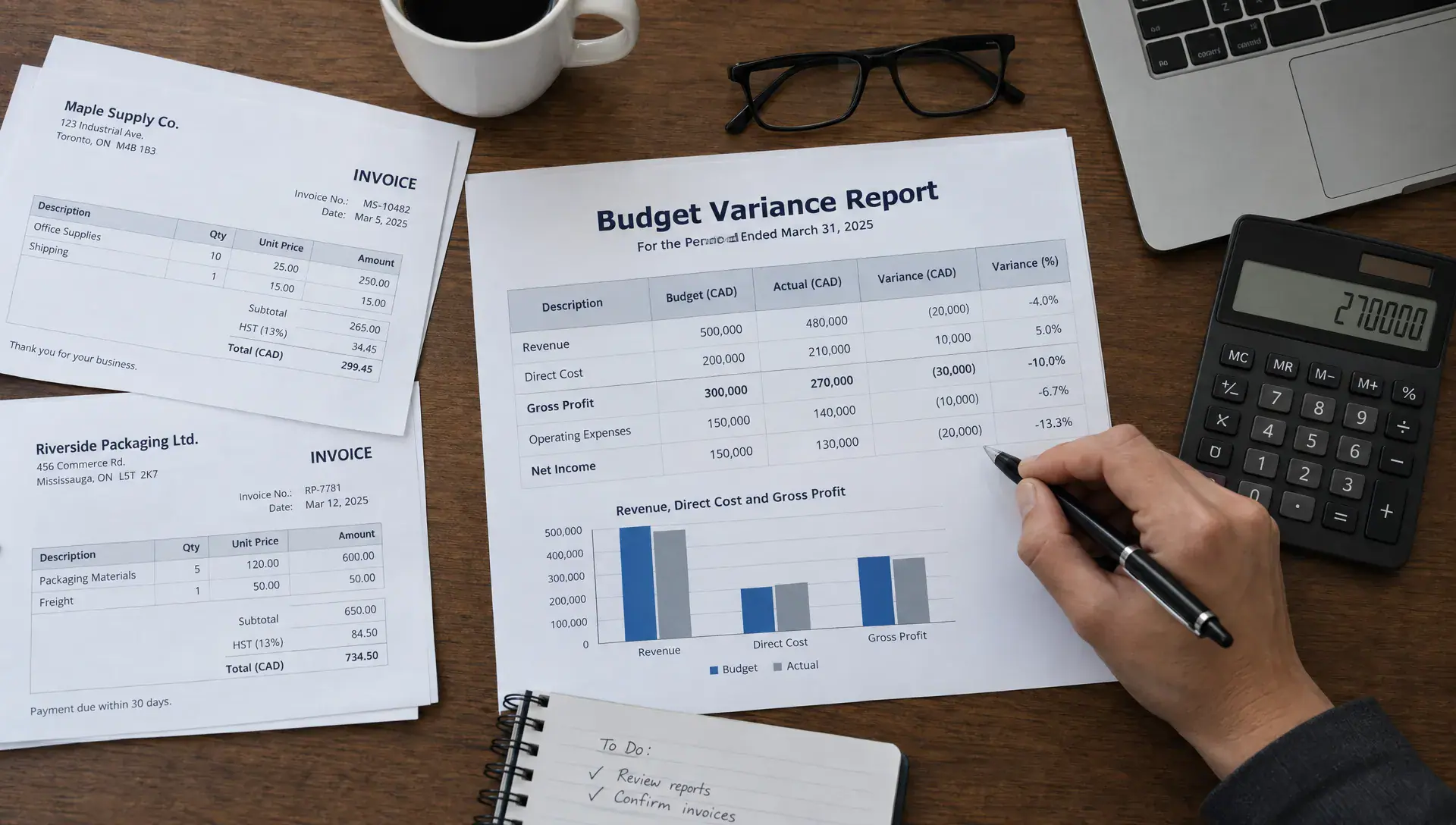
The report should be short enough to use, but specific enough to support action. For each significant variance, record the actual amount, budget amount, dollar difference and percentage difference, followed by an explanation supported by evidence.
The most useful commentary also includes:
- Expected duration: Whether the difference is temporary, recurring or still under investigation.
- Management response: The decision or investigation needed, rather than a vague instruction to monitor spending.
- Accountable owner: The person responsible for obtaining evidence or carrying out the response.
- Follow-up date: When the team will check whether the action worked and whether the forecast needs updating.
Agree on a review timetable that suits the business. Complete the accounting checks first, obtain explanations from department owners and then hold a focused management discussion. Where records are incomplete, label the result as provisional rather than presenting false precision.
The value of CPA services lies partly in challenging explanations before they become accepted assumptions. “Supplier prices increased” should be tested against invoices and contracts; “sales will recover next month” should be supported by orders or other credible evidence.
At the next review, revisit earlier actions. A variance process is incomplete if each month starts a new conversation without checking whether previous decisions improved the result.
Frequently asked questions
How often should a business review budget variances? Monthly reviews are a useful baseline for many businesses. Review selected indicators more frequently when margins are tight, cash is constrained or operating conditions change quickly. The frequency should match how soon management can take meaningful action.
Is spending below budget always favourable? No. Lower spending may reflect reduced activity, delayed maintenance, unfilled roles or missing invoices. Compare costs with the activity achieved and check whether the reduction creates future costs or service problems.
Should the budget be revised whenever actual results differ? Not automatically. Preserve the approved budget as the original reference point and update the forecast separately. If management formally revises the budget, retain the earlier version and document the changed assumptions so accountability is not lost.
Make the next variance review more useful
If your reports show differences without explaining their causes, discuss your reporting needs with Reach Professional in Oakville. Its business advisory and fractional CFO services offer a relevant starting point for that conversation.
Bring your current budget, recent financial statements and two or three unexplained variances. Ask what reporting scope, supporting records and review cadence would help you turn those differences into timely decisions.