

Cash payments are easy to accept and harder to trace once receipts, till counts and bank deposits stop matching. Effective bookkeeping services for businesses connect those records so owners can explain every dollar received, refunded, held or deposited.
For an Oakville retailer, GTA restaurant or appointment-based service business, the goal is not simply to enter transactions. It is to preserve reliable evidence of sales, protect cash on hand and prepare accurate tax records.
This guide explains what a cash-focused bookkeeping arrangement should cover, how the daily workflow should operate and what to confirm before hiring a provider.
Why bank transactions do not tell the whole story
A bank feed shows money deposited, not necessarily everything customers paid. A business might retain a float, issue cash refunds or use receipts to fund an approved purchase before visiting the bank. Recording deposits alone can therefore understate sales or misclassify transactions.
The opposite problem also occurs. If sales are already recorded through a point-of-sale system, categorizing the subsequent bank deposit as new revenue counts the same income twice. Transfers between the till, safe and bank need their own accounting trail.
Cash controls should answer three questions: what should be present, what was actually counted and why any difference exists. A monthly bank reconciliation cannot answer those questions without reliable daily records. Missing source documents create uncertainty that software cannot resolve on its own.
What bookkeeping services for businesses should cover
A suitable engagement should connect frontline cash handling with the general ledger, bank reconciliation and tax records. Transaction entry is only one part of that process.
For a cash-handling business, the agreed scope should address:
- Sales recording: Capture gross sales, taxes, refunds and payment methods from reliable source records.
- Cash reconciliation: Compare expected cash with till counts, safe balances and deposit records.
- Account coding: Distinguish revenue from customer deposits, loan proceeds, owner contributions and transfers.
- Exception handling: Investigate shortages, duplicate entries, missing receipts and unexplained adjustments.
- Month-end reporting: Reconcile relevant accounts and identify unresolved items for management.
Clarify responsibilities rather than assuming everything is included. Who counts the till? Who prepares deposits? Who reviews unusual refunds? Who supplies missing documents, and by what deadline?
Also distinguish bookkeeping from payroll processing, GST/HST return preparation, income tax filings and assurance work. A provider may offer several of these services, but the engagement should specify which are included, who reviews them and who remains responsible for approvals and payments.
An engagement letter should also explain how historical cleanup, software setup and additional review requests are priced. These can require work beyond the recurring monthly process.
Build a repeatable daily cash close
For cash-heavy operations, bookkeeping services for businesses work best when supported by a consistent closing routine at each location or register. Waiting until month-end makes discrepancies harder to reconstruct.
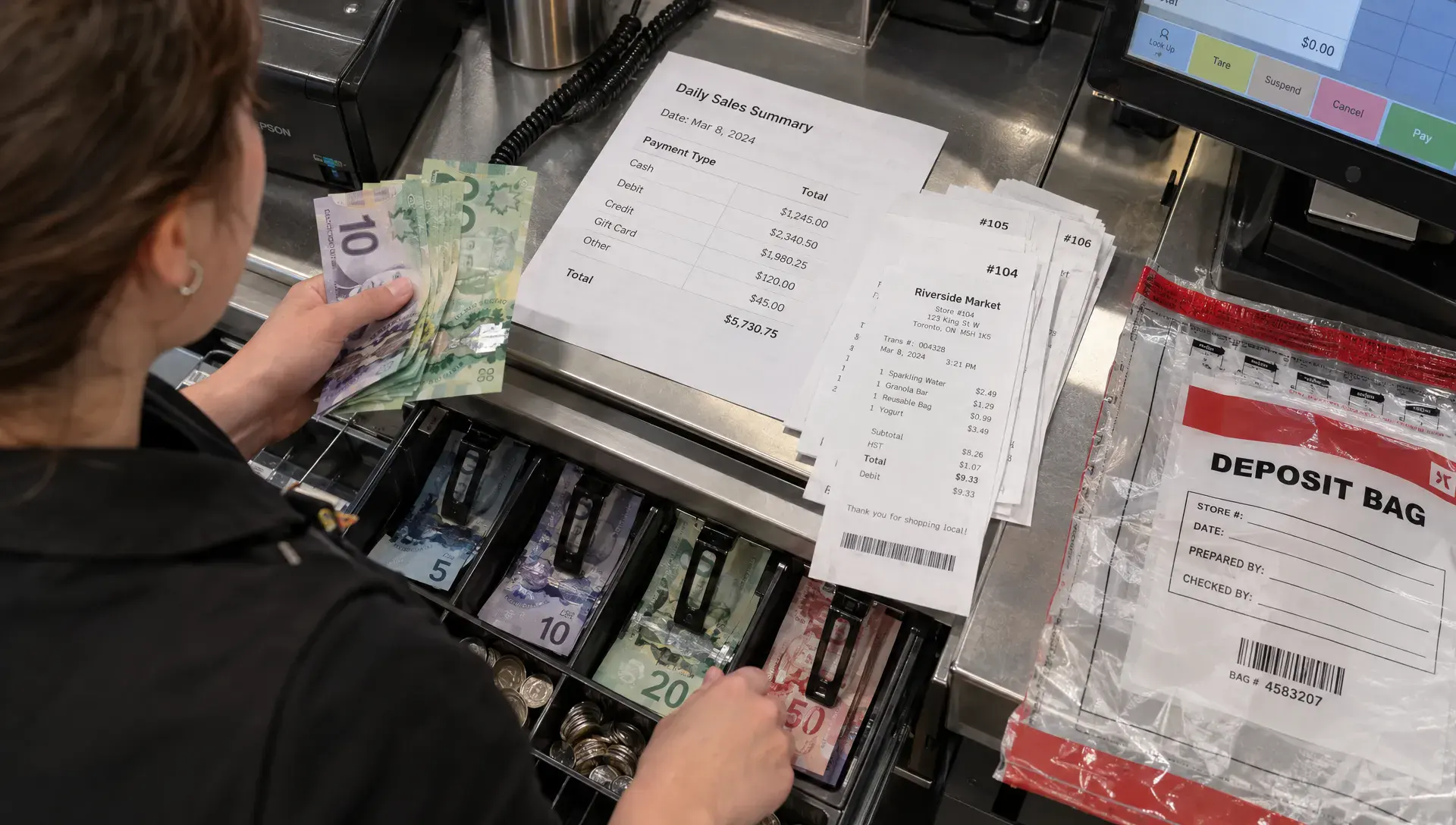
Start with a documented opening float. At closing, save the till summary or point-of-sale report showing sales by payment type, refunds, discounts and voids. Count physical cash separately from cheques, card receipts and other payment methods.
The basic relationship is:
Expected cash = opening float + cash received – cash refunds – authorized cash payouts – cash already removed.
Compare that expectation with the physical count. Record the difference immediately, with the date, register and staff member responsible for the close. Where practical, have another person verify the count or review the supporting evidence.
Do not change recorded sales simply to make the drawer balance. A shortage or overage belongs in a documented exception process, with an appropriate cash-over-or-short entry where justified. Repeated small differences deserve investigation just as much as an isolated large one.
Finally, document the amount retained as the next float and the amount transferred to the safe or deposit bag. The person reviewing the books needs that movement history, not just a photograph of the final bank receipt. Keep the closing report and count sheet together so they remain easy to retrieve.
Reconcile gross cash receipts to the bank deposit
A useful test of bookkeeping services for businesses is whether the provider can explain why cash sales and bank deposits differ without treating the difference as missing revenue.
Consider this simplified Ontario retail example. Assume all sales and refunds are subject to 13% HST, there are no other cash movements and the business retains its normal float.
| Cash movement | Amount |
|---|---|
| Opening float | $200 |
| Cash sales, including $130 HST | $1,130 |
| Cash refunds, including $13 HST | ($113) |
| Expected cash before deposit | $1,217 |
| Float retained | ($200) |
| Expected bank deposit | $1,017 |
Net sales are $900 and net HST collected is $117. The $1,017 deposit is not another sale. It transfers money already recorded from cash on hand to the bank.
A cash-on-hand or clearing account can help track these movements. The bookkeeper should reconcile its balance to documented cash still held, including amounts awaiting deposit.
Timing matters too. A weekend deposit may reach the bank after month-end even though the underlying sales occurred before it. Keep the deposit slip, closing records and bank confirmation together so the outstanding transfer can be explained.
If the bank receives a different amount, investigate the specific deposit. Do not spread an unexplained difference across several days simply to clear the account. That removes the evidence needed to find the cause.
Track cash payments outside the till
Not every cash receipt is an immediate sale. Customers may settle an existing invoice, pay an instalment or provide an advance payment. Effective bookkeeping services for businesses identify the underlying transaction before assigning an account.
When a customer pays an invoice already recorded as revenue, apply the receipt against accounts receivable. Recording it as another sale overstates income and leaves the original invoice looking unpaid. Advances may require separate liability tracking, with accounting and GST/HST timing reviewed independently.
Payment plans add another layer. Bright Smiles Dentistry, an Australian dental practice, lists payment plans and two Sunshine Coast locations. A Canadian practice with a similar operating structure would need records that distinguish locations, amounts billed and instalments collected, while applying Canadian tax rules.
Owner contributions and loan proceeds also need supporting documentation so they are not mistaken for customer revenue. Cash taken out by an owner should not automatically be classified as a business expense.
Keep petty cash separate where possible. Use an approved float, receipts and a replenishment record rather than informal withdrawals from sales proceeds. Cash wages likewise require proper payroll records and applicable deductions; paying in cash does not remove employer obligations.
Apply GST/HST rules to the transaction, not the tender
Receiving cash does not make a taxable sale exempt from GST/HST. Registered businesses must apply the relevant rules based on the supply, place of supply and applicable timing requirements.
Ontario's 13% HST applies to many taxable supplies, but not every business transaction has the same treatment. Exempt supplies, zero-rated supplies and mixed activities require appropriate coding. For example, many qualifying dental services are exempt, while some cosmetic services may be taxable.
Tax-aware bookkeeping services for businesses should preserve the distinction between sales revenue and tax collected. They should also retain the purchase documentation needed to support eligible input tax credits rather than assuming that every payment produces a credit.
The CRA's GST/HST guidance for businesses provides the starting point for registration, charging tax and reporting obligations. Confirm uncertain treatment with a qualified tax professional.
Agree on who prepares returns, who reviews unusual transactions and who authorizes remittances. A completed reconciliation does not mean a tax return has been filed or its balance paid.
Separate cash payments from cash-basis accounting
Accepting banknotes is a payment choice. Cash-basis accounting is a method of recognizing income and expenses. The two are not interchangeable.
Most Canadian businesses generally use accrual accounting for income tax purposes, subject to specific exceptions. Under accrual accounting, revenue can be recognized before collection, while an expense can arise before payment. A cash-paying customer does not change that framework.
This distinction becomes important when an invoice crosses month-end or a customer makes an advance payment. The collection date, revenue recognition date and GST/HST reporting date may need separate consideration.
If this affects your reporting, Reach Professional's explanation of cash versus accrual reporting explores the differences in more detail.
When comparing bookkeeping services for businesses, ask how the provider handles unpaid invoices, customer advances and period-end cutoffs. Categorizing every receipt as current-period revenue can distort results even when the bank account reconciles perfectly.
Preserve records that support the numbers
A deposit slip proves money reached the bank. It does not establish which customers paid, what they purchased or how much tax was collected.
Retain the supporting trail: sales receipts, invoices, till summaries, refund approvals, count sheets, deposit records and relevant purchase documents. Where a system produces daily sales summaries, preserve the underlying transaction detail as well.
The CRA generally requires records to be kept for six years from the end of the last tax year to which they relate, although exceptions and longer retention requirements can apply. Its recordkeeping guidance explains the general requirements.
Electronic records should remain readable, accessible and connected to the accounting entries. Confirm export options before changing software or ending a provider relationship. Access to a dashboard is not the same as possessing your records.
Use consistent file names and secure backups. A practical test is whether someone unfamiliar with the transaction could follow it from the original receipt through the ledger to the bank.
Protect cash and financial account access
Physical custody and bookkeeping access need separate controls. Ideally, the person receiving money should not independently control refunds, reconcile the records and approve adjustments without oversight.
Small teams cannot always separate every task. An owner can compensate by reviewing closing reports, checking unusual refunds and comparing deposits with independently obtained bank records. The review should leave evidence, such as a dated sign-off or recorded approval.
For digital access, require named user accounts, appropriate permissions and multi-factor authentication where available. Ask how the provider shares documents, protects confidential customer information and removes access when staff leave.
Reach Professional's guide to bookkeeping controls that protect financial data provides further context for account access and traceability.
Before engaging bookkeeping services for businesses, confirm who can initiate payments, change banking details or alter previously closed periods. Recording transactions should not automatically grant authority to move money.
Also ask how coverage works during absences. A substitute should receive approved access rather than another person's password. The business should retain control of its subscriptions and recovery credentials.
Use software and AI with accountable review
Point-of-sale integrations, receipt capture and bank feeds can reduce manual entry. They do not prove that every cash sale was recorded or that a physical count was accurate.
Before connecting systems, determine which application is the source of truth for sales. Establish how refunds, taxes, tips and payment types map into the ledger. Test the integration against a sample day before relying on automated posting.
AI-assisted tools can suggest categories, extract receipt details and flag unusual patterns. A person still needs to verify ambiguous tax treatment, distinguish transfers from sales and investigate missing evidence.
Ask who reviews automated entries and how corrections are recorded. An unexplained adjustment should not become acceptable merely because software generated it. Bookkeeping services for businesses should identify an accountable reviewer, not simply point to the automation platform.
Do not upload confidential financial or customer information into a public AI tool without appropriate authorization and a review of its data practices. Confirm compatibility with your existing systems, export capabilities and the process for correcting failed or duplicated imports.
Compare pricing against the actual workload
Cash-handling work is influenced by more than revenue. Two businesses with similar sales can require very different levels of reconciliation and follow-up.
Ask prospective providers to quote using your number of locations, registers, monthly transactions, bank accounts and payment systems. Disclose cash payouts, inventory, payroll, customer instalments and any backlog. Historical cleanup should be distinguished from recurring work.
Quotes may be hourly, fixed monthly or project-based. Compare the same scope rather than the headline amount. A lower fee may exclude daily cash reconciliation, document follow-up or review of discrepancies.
When evaluating bookkeeping services for businesses, ask what triggers additional charges and whether someone physically attends the premises. Remote bookkeeping can work well when staff supply reliable count sheets and deposit evidence; the provider cannot remotely verify notes in a drawer.
Keeping daily counts in-house while outsourcing reconciliation can be a practical division of work. The deciding factor is whether responsibilities are clear and records arrive on time.
Request a sample reporting format with confidential information removed. It should show how unresolved items are presented, not just display a polished income statement.
Plan the handover before changing providers
Choose a clear transition date and establish who completes the final reconciliation under the old arrangement. Switching systems does not resolve unexplained opening balances.
Before the handover, gather accounting exports, bank statements, outstanding invoices, unpaid bills, tax account balances and supporting records for customer advances. Include point-of-sale settings, tax mappings and the latest reconciled cash-on-hand balance.
Count physical cash at the transition date and document amounts held in tills, safes and pending deposits. Compare those figures with the ledger. Any difference needs investigation or a supported adjustment approved by the appropriate person.
Agree on ownership of the software subscription and arrange named access for the incoming provider. Remove former access only after necessary records and responsibilities have transferred securely.
Reliable bookkeeping services for businesses should establish opening balances, document unresolved issues and set a timetable for the first close. Ask who will answer historical questions after the transition and whether that support costs extra.
A short overlap can help when several locations or payment systems are involved. Define its purpose and end date so transactions are not posted twice by different teams.
Turn the monthly close into useful decisions
A cash-focused monthly report should do more than show profit. It should explain the relationship between recorded sales, cash collected, money deposited and cash still held.
Review shortages and overages, aged undeposited cash, unusual refunds and balances awaiting explanation. Compare locations or registers where the records support a fair comparison, accounting for differences in sales volume and operating hours.
A recurring shortage might reflect counting errors, undocumented payouts, training gaps or misconduct. The numbers identify where to investigate; they do not establish the cause without supporting evidence.
Set a close deadline and a process for resolving outstanding questions. Owners should know whether reported results are final or still depend on missing documents.
The practical value of bookkeeping services for businesses is a financial record that supports decisions and can be checked. If cash discrepancies repeatedly remain unresolved, address the collection process rather than accepting another month of unexplained adjustments. Assign each open item an owner and a resolution date.
Frequently asked questions
Can I record bank deposits instead of individual cash sales? Deposits alone usually do not provide enough detail. You need supporting sales records that identify revenue, taxes, refunds and other movements. Appropriate daily summaries may be used, but the underlying records must remain available.
How often should cash be reconciled? Count and reconcile active tills daily or at each shift close, depending on operations. Reconcile bank accounts and ledger balances on an agreed schedule, commonly monthly, with more frequent review where volume or risk warrants it.
Can ChatGPT do my cash bookkeeping? It can help explain concepts or draft procedures, but it cannot physically count cash or establish whether missing transactions occurred. AI-assisted entries still require reliable source documents, privacy safeguards and accountable human review.
Will a bookkeeping package include my tax returns? Not necessarily. When comparing bookkeeping services for businesses, confirm whether GST/HST returns, payroll filings and income tax preparation are included. Also clarify who reviews them, authorizes submission and tracks payment deadlines.
Discuss a cash-focused bookkeeping scope
Reach Professional provides bookkeeping, accounting and tax services for businesses in Oakville and the GTA. Explore its professional bookkeeping services and discuss your cash volumes, payment systems and current reconciliation challenges. Agree on responsibilities and deliverables before work begins so daily records support a dependable monthly close.