


A missing T4 or an incorrect investment slip can leave you unsure what to report. Professional tax services help you reconcile the income, document any estimates and decide whether a return needs correcting, rather than simply copying whatever appears in your CRA account.
For Oakville business owners, incorporated professionals and people with employment or side-business income, the priority is the same: report the right amounts without missing a filing deadline or counting income twice. The next step depends on whether the slip is missing, inaccurate or unnecessary for reporting the income.
First, identify the problem with the slip
Before changing your return, compare the document with your own records. An unfamiliar amount is not necessarily an error: taxable benefits, investment distributions and payroll adjustments can explain differences.
| Situation | What to check | Practical next step |
|---|---|---|
| A slip has not arrived | Issuer account, mailing address and CRA records | Request a replacement and gather supporting statements |
| Income or tax deducted looks wrong | Year-end payroll totals, transaction records and benefit details | Ask the issuer to explain or correct the amount |
| Two slips appear to cover the same income | Issuer, tax year, account and amendment status | Determine whether one replaces the other |
| Business income has no slip | Invoices, platform reports and payment records | Reconcile revenue rather than waiting for a slip |
Keep a short log of whom you contacted, when you contacted them and what remains unresolved. That record helps your preparer distinguish confirmed information from an estimate.
How professional tax services track down missing slips
Start with the organization responsible for issuing the document. An employer, financial institution, pension administrator or other payer may have an online copy available even when the mailed version has not arrived.
Check your CRA account as well. The CRA’s guidance on tax slips explains how to obtain slips and what to do when information is missing. However, an empty account does not prove there was no income. Issuer submissions and CRA processing may not yet be complete.
Reconstruct amounts from reliable records
If the slip remains unavailable as the filing deadline approaches, gather evidence that supports the amounts to report. Useful records include final pay statements, pension statements, investment statements and written confirmations from the payer.
A bank deposit alone rarely establishes gross employment income because it usually reflects net pay after deductions. Likewise, investment cash received may not match taxable income allocated on a slip.
When records disagree, professional tax services can help build a documented calculation rather than treating one unexplained balance as correct. The working papers should identify the source of each amount, the assumptions used and anything awaiting confirmation.
Do not invent tax withheld or claim deductions merely to make an estimate resemble last year’s return. Follow CRA instructions for your filing method concerning supporting explanations and keep the underlying documents available if requested.
What to do when a tax slip is incorrect
Ask the issuer to review the specific discrepancy. Provide the tax year, relevant box number, amount shown and evidence supporting your concern. Avoid sending a full package of sensitive documents when a targeted explanation will do.
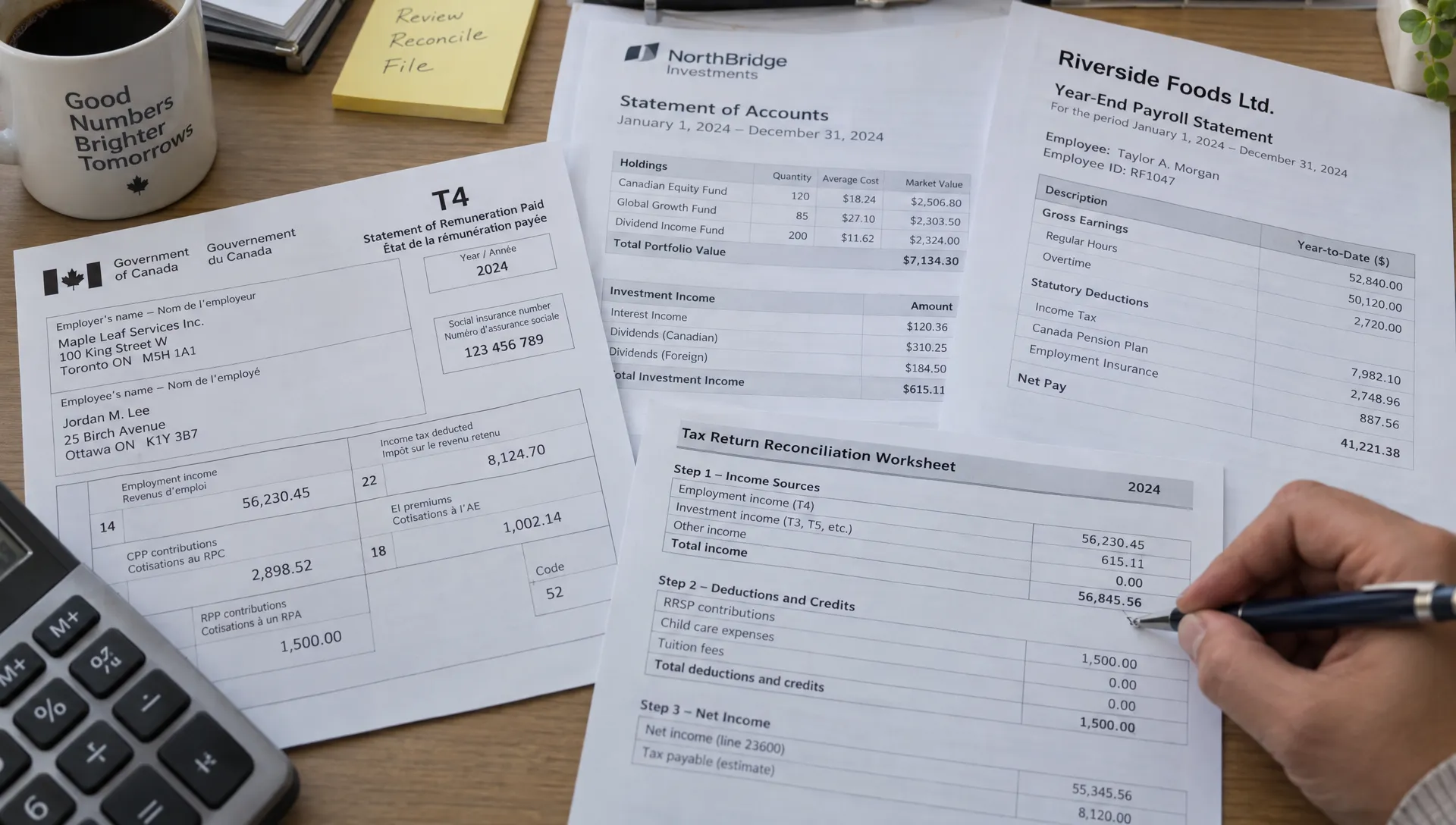
For example, suppose your final payroll statement shows different employment income from your T4. The difference could reflect an error, but it could also involve a taxable benefit or year-end adjustment. Request a reconciliation before assuming the slip should match cash deposited into your account.
An issuer’s amendment and a correction to your tax return are separate processes. If the issuer agrees that its slip is wrong, ask when it will submit an amended version and provide your copy. Do not assume the amendment will automatically produce the right result on a return already filed.
Where an issuer disputes the error or cannot resolve it before filing, professional tax services can assess the evidence and determine an appropriate reporting approach. Retain the original slip, correspondence and any replacement, clearly identifying which version supports the return.
For an unfamiliar issuer or income you never earned, investigate promptly with the issuer and CRA. Do not simply delete the slip without addressing the possibility of an identity or reporting problem.
No T4A does not necessarily mean no taxable income
A slip is an information document, not the sole test of whether income must be reported. Consulting fees, freelance work, affiliate commissions and other business receipts may need reporting even when no Canadian slip arrives.
For readers exploring an online side business through Haley Marie Blog’s business and affiliate marketing resources, an early bookkeeping habit matters: record commissions and related fees from the first payment rather than waiting for a year-end document.
Reconcile payer statements with invoices, platform reports and deposits. Where a platform deducts fees before paying you, the deposit may not represent gross revenue. Foreign-currency transactions also need a supportable conversion to Canadian dollars, and foreign activities can create additional reporting questions.
For a side business already recorded in your books, professional tax services should reconcile any T4A against existing revenue rather than add it again. A payer’s slip can confirm income already included in your accounts; it does not necessarily represent additional sales.
This is also a reason to keep employment and business income clearly separated. The absence or presence of a particular slip does not, by itself, settle whether someone is an employee or an independent contractor.
Protect the filing deadline while resolving the discrepancy
Waiting indefinitely for a corrected document can create a second problem: a late return. For most individuals, the filing deadline is April 30. Individuals carrying on a business, and their spouses or common-law partners, generally have until June 15 to file, although payment is generally due April 30. Weekend and public-holiday rules can affect the applicable date.
These are personal-return rules. Corporate returns, payroll information returns and trust returns have different deadlines.
When a document remains outstanding, professional tax services can help separate what is known, what can reasonably be reconstructed and what requires further investigation. Filing with supported amounts and correcting them later may be preferable to missing a deadline, but the treatment must fit the facts.
Do not assume an extension to file is an extension to pay. Estimate any balance owing using the best available information and discuss unresolved amounts with your preparer before the payment deadline.
Already filed? Correct the return without creating duplicates
If a missing or amended slip arrives after filing, first compare it with the amounts already reported. A return prepared from accurate records may need no change. A different slip amount may require an adjustment, but it should not automatically be added on top of the original income.
Generally, wait until you receive your notice of assessment before requesting a change. The CRA describes available methods, including Change my return, ReFILE and a paper adjustment request, in its instructions for changing a return. Eligibility varies by method and return.
At this stage, professional tax services can reconcile the filed figures, the assessed figures and the new evidence before submitting an adjustment. That comparison is especially useful if CRA has already changed the return using information supplied by an issuer.
Do not submit a second original return to correct the first one. Also distinguish a routine adjustment from a formal dispute: an objection has its own requirements and deadlines. If CRA correspondence arrives, follow the approach in our guide to which CRA notices to send to your tax professional so the response addresses the right issue.
Investment slips need more than a matching deposit
Investment documents deserve particular care because cash movement and taxable amounts can differ. A T3 may report trust income allocations that do not match distributions received in cash. A T5008 reports securities transactions, but its cost information may not establish the correct adjusted cost base for calculating a gain or loss.
Missing investment records can therefore require transaction histories, purchase confirmations, reinvested distribution details and records of transfers between accounts. Selling proceeds alone do not establish the taxable gain.
For these cases, professional tax services should examine the underlying transactions rather than rely exclusively on downloaded slip data. Ask specifically who will calculate adjusted cost base and whether the quoted scope includes reconstructing older transactions.
The same discipline applies to duplicate-looking investment slips. Two documents from different account numbers may both be valid, while an amended slip may replace an earlier version. Compare identifying details before removing or combining anything.
What to prepare before your appointment
A focused package reduces follow-up questions and helps the preparer identify gaps. Include:
- All relevant slip versions: Original, amended and cancelled documents, with the date each was received.
- Supporting records: Final payroll statements, investment activity, invoices and payer statements that explain the disputed amount.
- Correspondence: Messages with the issuer, promised correction dates and relevant CRA letters.
- Filing information: The return already submitted, notice of assessment and details of any pending adjustment.
- A discrepancy summary: What appears wrong, your calculation and the evidence supporting it.
Organizing these records before engaging professional tax services also makes it easier to agree on scope and responsibilities. For business income, Reach Professional’s bookkeeping services can support the underlying recordkeeping that a reliable reconciliation requires.
Ask how sensitive documents should be transferred. Do not share your CRA password or multi-factor authentication codes; representative access should use CRA’s authorization process. Keep supporting records and calculations, generally for at least six years from the end of the tax year concerned, with longer retention where applicable.
Choosing the right help for an unresolved slip
A straightforward replacement request is different from disputed employment income, incomplete investment cost records or foreign-source income. Explain the complication before hiring someone so the engagement covers the actual work required.
“Tax preparer” does not necessarily mean “CPA.” If a provider advertises CPA credentials, verify the individual’s status through the relevant provincial body, such as CPA Ontario. Ask about experience with your particular issue, not just general return preparation.
Before committing to professional tax services, confirm whether the fee includes issuer follow-up, reconstruction work, an adjustment after assessment and responses to CRA questions. Our guide to what a tax engagement letter should cover explains how written responsibilities can prevent misunderstandings.
For employers correcting slips they issued, the work is different again. Updating the payroll ledger alone does not correct information already submitted to CRA; the applicable slip-amendment process also needs attention.
Frequently asked questions
Can I file without a T4? Yes, missing a T4 does not automatically prevent filing. Request it from your employer, check CRA records and use reliable supporting information if it remains unavailable. Keep the calculation and evidence supporting the amounts reported.
Will CRA automatically fix an incorrect slip? Do not rely on that. CRA may compare your return with issuer information, but that does not establish which amount is correct. Resolve the discrepancy with the issuer and monitor your assessment.
Can professional tax services help after I receive a reassessment? Yes. A preparer can compare the reassessment with your records and identify whether an adjustment, supporting-document response or objection is appropriate. Seek help promptly because response and objection deadlines can apply.
Should I report both an original and an amended slip? Not as separate income when the amended slip replaces the original. Confirm the issuer, account, tax year and amendment details before finalizing the return.
Discuss the missing information with Reach Professional
Reach Professional provides tax planning and compliance, bookkeeping and business advisory services for Oakville and GTA businesses. Contact Reach Professional to discuss the missing or disputed information, your filing status and the work needed to reconcile your records. Bring the documents you have, even if the issuer has not yet resolved the problem.